

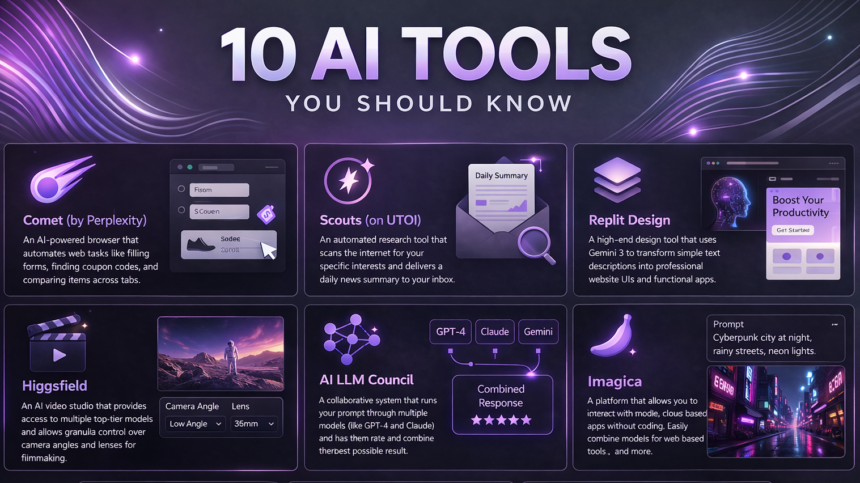
This report analyzes a curated suite of ten specialized 10 AI Efficiency Catalysts, including Whisper Flow, Comet, and N8N, designed to automate high-friction workflows. Leveraging backbones like Gemini 3 and specialized LLM ensembles, these tools target developers, content creators, and business analysts seeking to eliminate manual data entry and creative bottlenecks.
Modern Efficiency: The 2026 Value Proposition
The shift from reactive software to proactive agentic systems is the defining characteristic of 10 AI Efficiency Catalysts. Professionals clinging to fragmented workflows risk obsolescence as the cost of manual synthesis rises relative to automated precision. By adopting neural interfaces like Whisper Flow or the AI LLM Council, you move beyond simple prompting into a realm of multi-model orchestration.
Performance Benchmarks & Accuracy
When evaluating 10 AI Efficiency Catalysts, the primary metric of success is the reduction of hallucination rates through cross-model verification. Tools like the AI LLM Council utilize a “mixture of experts” approach, where different models peer-review outputs to ensure factual density. While Gemini 3 provides an expansive context window—often exceeding two million tokens—the risk of “middle-of-the-document” forgetfulness remains a minor concern for extremely large datasets. Users must balance the high-velocity output of Higgsfield’s video generation with the need for manual prompt refining to avoid temporal inconsistencies in long-form cinematic renders.
2026 Tool Utility Breakdown
| Tool Category | Core Interest | Technical Highlight |
| Dictation | Whisper Flow | 4x faster than typing (~220 wpm); supports 100+ languages. |
| Browsing | Comet | Agentic sidebar that clicks links and manages tabs on your behalf. |
| Research | Scouts (UTOI) | Personalized news “Scouts” that deliver contextual daily briefings. |
| Video | Higgsfield | Aggregates 15+ models (Sora 2, Veo 3.1) with 70+ camera presets. |
| Images | Nano Banana Pro | Subject retention for consistent characters across multiple images. |
| Audio | SAM Audio | “Segment Anything” technology that isolates voices from background noise. |
| Automation | N8N | Low-code builder for creating autonomous “AI Agents” and workflows. |
Workflow Synthesis: Bridging Manual Labor and Automation
The synthesis of 10 AI Efficiency Catalysts into a singular professional workflow begins with the elimination of the keyboard bottleneck via Whisper Flow’s context-aware voice processing. Instead of manually drafting project briefs, a consultant can dictate raw thoughts into Comet, which then automates the research phase by scanning live market data and specific stock fluctuations.
Ethical Guardrails & Data Sovereignty
In an era where data is the primary currency, the 10 AI Efficiency Catalysts suite addresses sovereignty through a mix of local-first processing and transparent training opt-outs. Kimmy Slides: An AI presentation generator specifically designed to create data-dense slides featuring complex charts and professional layouts. If you want more information about AI visit Savitimes.
By maintaining data sovereignty, users can ensure their automated workflows remain competitive without compromising intellectual property or ethical standing in a crowded marketplace. For further reading on neural safety, refer to the Google DeepMind technical documentation.
AI Capability FAQs
Does it support multimodal input? Yes, the majority of the 10 AI Efficiency Catalysts support multimodal processing. For example, Nano Banana Pro handles text-to-image prompts with spatial awareness, while Higgsfield and Google Flow process video-to-video and text-to-video instructions, allowing users to upload reference frames or sketches to guide the final high-fidelity output.
How does it handle complex reasoning? Complex reasoning is managed through “Chain of Thought” processing and multi-model consensus. The AI LLM Council specifically breaks down a single prompt into sub-tasks, assigns them to the most capable model, and then utilizes a “Council Leader” model to synthesize the fragmented answers into a cohesive, logical solution that exceeds the capability of any single LLM.
Is there a free tier? Most tools within the 10 AI Efficiency Catalysts ecosystem offer a freemium model. Whisper Flow, Scouts (via UTOI), and N8N provide substantial utility at the free tier, though high-volume API access, SOC2 compliance features, and the more powerful “Pro” versions of Nano Banana or Higgsfield typically require a monthly subscription.