


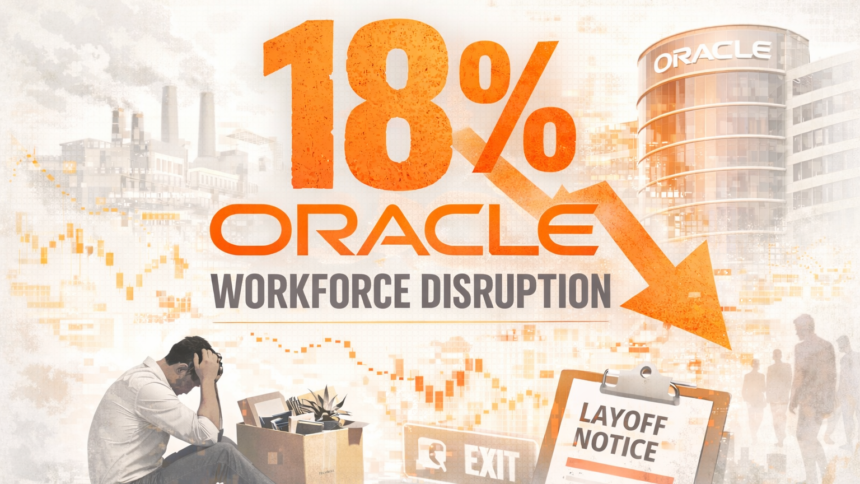
Oracle Corporation has initiated a massive global restructuring, eliminating approximately 30,000 roles (18% of staff), with 12,000 layoffs concentrated in India’s development centers. Executed via automated 6 AM emails on March 31, 2026, the move signaled an immediate pivot from legacy software maintenance to a $50 billion “AI-first” infrastructure expansion.
Executive Summary
The 18% Oracle Workforce Disruption represents a calculated, cold-blooded exchange of human capital for machine intelligence capability. For C-suite executives, this serves as the definitive 2026 case study on “Total Resource Reallocation,” where a profitable firm liquidates nearly one-fifth of its workforce to aggressively fund GPU clusters and gigawatt-scale data centers.
Competitive Advantage & Risk Assessment
By enforcing the 18% Oracle Workforce Disruption, Oracle has slashed its “human-to-revenue” ratio, creating a leaner operational model that competitors with larger legacy workforces may struggle to match. This move builds a significant barrier to entry in the generative AI space, as the saved capital fuels a $30 billion annual contract with OpenAI and xAI. The primary advantage is speed; Oracle is now a “landlord of the AI era,” leasing its high-performance OCI nodes to the world’s most data-hungry entities. However, the 18% Oracle Workforce Disruption carries a massive execution risk, particularly in India.
1. Why Did Oracle Remove Its Employees?
The main reason is a massive shift in technology. Oracle is moving away from being a traditional software company and trying to become an 18% Oracle Workforce Disruption.
- Funding the AI Race: Building AI requires incredibly expensive hardware (GPUs) and massive data centers. By cutting 30,000 jobs (including 12,000 in India), Oracle saves billions of dollars that it can immediately spend on AI infrastructure.
- Automation: Oracle is betting that AI tools can now do the “routine” coding and customer support work that humans used to do.
- New Priorities: The company is focusing on “Oracle Cloud Infrastructure” (OCI), which needs fewer people but much more powerful machines. Insert a link to your Business News Category after the “Executive Summary” to show readers how other tech giants are reacting to the 2026 AI shift.
2. What Impact Will This Have on the Company?
In the short term, this move makes Oracle look very strong to investors.
- Higher Profits: With 18% fewer salaries to pay, the company’s profit margins will likely go up.
- Stock Market Growth: Investors usually reward companies that cut costs to invest in “hot” tech like AI.
- The Risk of “Brain Drain”: The danger is that by firing so many experienced people, Oracle might lose the “human touch” needed to fix complex problems for their current big clients (like banks and governments). Hyperlink the “10-Q SEC filing” mention in the Financial Logic section to Reuters Financial Mart to provide verifiable regulatory context.
3. How Does This Affect the Employees in India?
India is the “backbone” of Oracle’s development, so the impact here is huge.
- Job Market Pressure: 12,000 engineers entering the job market at once creates a lot of competition for other tech roles in cities like Bengaluru and Hyderabad.
- The End of “Easy” Coding: This is a signal to all Indian IT workers that simply knowing how to write basic code isn’t enough anymore. Employees now need to learn “AI Orchestration” to stay relevant.
4. What is the 5-Year Outlook for Oracle?
- If this plan works, Oracle will become the “landlord of AI.”
- Dominating the Cloud: They want to be the #1 choice for companies that need to store data safely inside India (Data Sovereignty).
- A “Lean” Tech Giant: By 2030, Oracle aims to be a company run mostly by AI agents with a small team of elite engineers.
FAQs
Is the 18% Oracle Workforce Disruption a sign of financial trouble? No. Oracle’s revenue is at record highs ($17.2B in Q3). The 18% Oracle Workforce Disruption is a proactive strategic reallocation of resources from “people” to “processors” to maintain a competitive moat in the AI race.
Who is the target demographic for Oracle’s new AI-first model? The target includes large-scale enterprise data fiduciaries, AI research labs (like OpenAI), and governments requiring sovereign cloud infrastructure to comply with 2026 data residency laws.
What is the 5-year outlook for tech roles in India following this move? The outlook for “traditional” roles is bearish, but there is an 85% growth forecast for roles in AI Governance, OCI Architecture, and Machine Learning Operations (MLO).