

The Market Pulse
The demand for agile software engineers remains at an all-time high, with 6-Month Tech Placement Strategy salaries for product-based roles ranging from $70,000 to $115,000 (₹12L–₹45L in India). For 2026, the “Future-Proof” rating is 9.5/10, provided candidates integrate AI-co-pilot proficiency with core Data Structures and Algorithms (DSA).
Here is the “no-nonsense” breakdown of what people should actually know about this roadmap:
1. The “4+2” Rule is Non-Negotiable
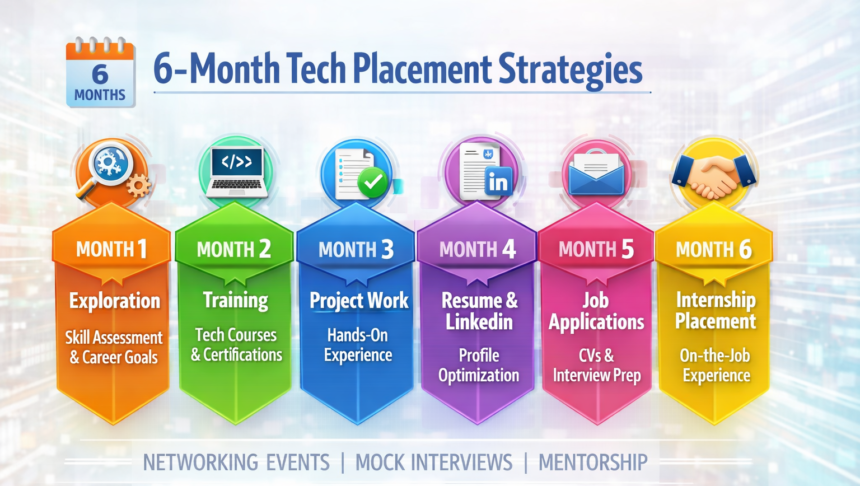
The strategy divides your six months into two distinct phases.
- Months 1–4 (The Foundation): This is purely about Data Structures and Algorithms (DSA) for 6-Month Tech Placement Strategy, Even in 2026, the “Big Tech” interviews (Google, Amazon, etc.) still use DSA to test your logic. If you can’t solve a “Medium” LeetCode problem manually, an AI co-pilot won’t save you in a live technical round.
- Months 5–6 (The Portfolio): This is where you build. By 2026, “To-Do lists” and “Weather apps” are considered filler. You need 2–3 high-impact projects that solve real problems (e.g., a RAG-based AI chatbot or a cloud-deployed microservice).
2. AI is a Tool, Not a Crutch
One of the biggest misconceptions is that AI makes learning to code unnecessary. In reality:
- Boilerplate is gone: AI tools like GitHub Copilot or Cursor now handle about 40–50% of routine code (like setting up APIs or basic CSS).
- Architecture is king: Recruiters in 2026 are looking for System Design skills. They want to see if you understand how to connect a frontend to a PostgreSQL database via a secure backend, not just if you can write a
forloop.
3. The “7.5 CGPA” Reality Check
While skills are paramount, the 2026 placement season has seen many firms implement an “Internal Filter.”
- Many companies list a 7.0 CGPA requirement but silently prioritize candidates with 7.5 or 8.0+ because of the sheer volume of applicants.
- If your CGPA is lower, your GitHub Portfolio and LinkedIn networking must be twice as strong to get a referral and bypass the initial automated screening.
4. Salary Expectations in 2026
The gap between “Service-based” and “Product-based” roles has widened.
- Service-based (TCS, Infosys, Wipro): Starting salaries typically range from ₹4L to ₹7L.
- Product-based/Startups: For those who follow the full 6-month roadmap and master “Skill-Stacking” (e.g., Java + Spring Boot + Cloud), salaries are starting between ₹12L and ₹25L.
5. The “Hidden” Skills: English & Soft Skills
In 2026, being a “silent coder” is a career killer. Since AI can write the code, your value lies in explaining it.
- Mock interviews are now essential—not just for the tech, but to ensure you sound confident and collaborative.
- You must be able to communicate your technical decisions in clear English.
Career Progression & Salary Table
The following trajectory represents the expected growth for candidates who successfully execute a 6-Month Tech Placement Strategy and enter the product-based ecosystem.
| Career Level | Experience | Expected Salary (Global/India) | Key Certifications/Skills |
| SDE Intern | 0 Years | $3k–$8k Monthly / ₹40k–₹1.5L | OCI, AWS Cloud Practitioner |
| Junior SDE | 0–2 Years | $80k–$120k / ₹12L–₹25L | Professional Cloud Developer |
| Mid-Level SDE | 2–5 Years | $130k–$190k / ₹30L–₹65L | System Design (HLD/LLD) |
| Senior/Lead SDE | 5+ Years | $200k+ / ₹70L–₹1.5Cr+ | Staff Engineer Leadership |
The AI-Co-Pilot Reality
The day-to-day life of a software engineer has been fundamentally altered by AI-driven development. Tools like Gemini and GitHub Copilot are no longer “cheating” but are required components of a modern workflow. In a 6-Month Tech Placement Strategy, you must learn to use AI to work 10x faster. This involves using AI for boilerplate code generation, rapid debugging, and unit testing. Explore our comprehensive Technical Certifications Guide to choose between OCI and AWS for your stack.
Stay updated on the latest workforce trends via the World Economic Forum’s Future of Jobs Report.
However, the trap lies in over-reliance. To remain elite, you must use AI to understand the why behind the code. Use these tools to explain complex space-time complexity or to refactor your Java Spring Boot controllers for better performance.
3 Career FAQs
1. What is the fastest way to break into this field? The most efficient route is the “4+2” approach: 4 months of intensive DSA (solving 150–200 classical questions) followed by 2 months of focused project building in a niche like Web or App development for 6-Month Tech Placement Strategy.
2. Is a degree required for high-paying tech roles? While many top firms still look for a B.Tech in CSE, the industry is shifting toward “Skill-First” hiring. A strong GitHub portfolio and contributions to Open Source (like GSoC) can often outweigh a non-traditional educational background.
3. How to negotiate a remote-work salary? Benchmark your skills against global standards using the LinkedIn Economic Graph. Highlight your proficiency in asynchronous communication and your ability to deliver high-quality code independently using AI tools.