


The Hidden Power Move Behind India’s First Underwater Railway Corridor
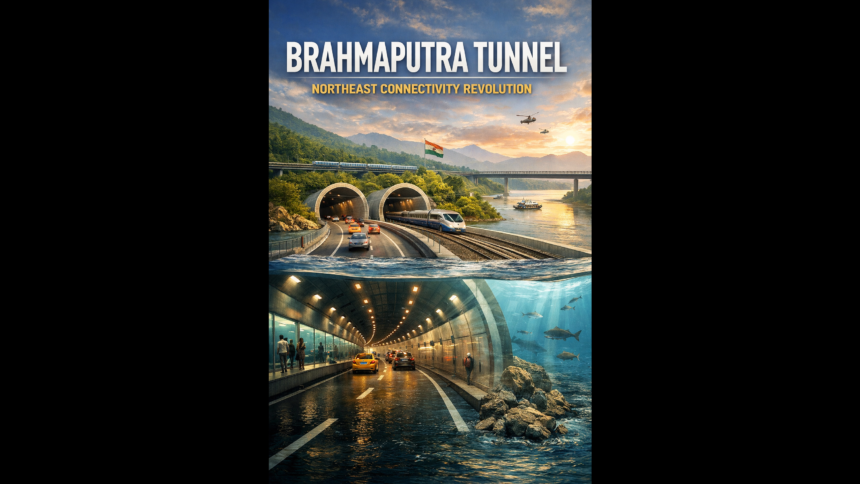
The landscape of Indian infrastructure reached a historic zenith on February 13, 2026, as the Cabinet Committee on Economic Affairs (CCEA) officially sanctioned the Brahmaputra Rail-Road Twin Tunnel. Chaired by Prime Minister Narendra Modi, the committee greenlit this ₹18,662.02 crore mega-project, marking India’s inaugural venture into underwater road-cum-rail engineering. This strategic corridor will span a total of 33.7 kilometers, featuring a massive 15.79-kilometer twin-tube tunnel section submerged deep beneath the turbulent waters of the Brahmaputra River. By utilizing high-tech Tunnel Boring Machines (TBM), the government aims to establish a resilient link that integrates the north and south banks of Assam like never before.
A 360-Minute Journey Slashed to a 20-Minute Blitz
One of the most transformative aspects of the Brahmaputra Rail-Road Twin Tunnel is its ability to rewrite the geography of the Northeast. Currently, travelers moving between Gohpur and Numaligarh must endure a grueling 240-kilometer detour via the Kaliabhomora bridge, a journey that frequently exceeds six hours. Once this four-lane access-controlled greenfield corridor is operational, that distance will shrink to a mere 34 kilometers. Commuters will experience a revolutionary reduction in travel time, crossing the river in approximately 20 to 30 minutes. This shift is expected to save millions in fuel costs and drastically lower the carbon footprint of regional logistics.
The Dual-Purpose Shield for National Security
Beyond its civilian utility, the Brahmaputra Rail-Road Twin Tunnel serves as a vital strategic asset for the Ministry of Defence. Its design facilitates the rapid and covert movement of military personnel, heavy artillery, and essential supplies to the sensitive border regions of Arunachal Pradesh. Unlike surface bridges, which are vulnerable to both natural disasters and external threats, an underwater tunnel at a depth of 32 meters offers unparalleled security. The project’s unique configuration allows for one tube to house a single electrified railway track with a ballastless design, ensuring that the Indian Railways can maintain high-speed operations even in the most challenging terrain.
Economic Revival and the Act East Integration
The approval of the Brahmaputra Rail-Road Twin Tunnel is a cornerstone of India’s “Act East” policy, designed to turn the Northeast into a thriving economic gateway. By connecting 11 economic nodes and 8 logistics hubs, the tunnel will serve as a catalyst for industrial growth and tourism. Government reports anticipate the creation of 80 lakh person-days of employment, providing a massive boost to the local labor market. The corridor will seamlessly integrate with major national highways like NH-15 and NH-715, as well as the Rangia-Murkongselek railway section, creating a multi-modal transport network that links airports and inland waterways across the region.
Pioneering Technology in a Seismically Sensitive Zone
Building the Brahmaputra Rail-Road Twin Tunnel requires a level of engineering sophistication rarely seen on the global stage, as it will be only the second such integrated tunnel in the world. The project will be executed via the Engineering, Procurement, and Construction (EPC) mode to ensure streamlined management and technical precision. Engineers must navigate the complex geological and seismic challenges of the Assam valley, ensuring the structure can withstand high water pressure and tectonic activity. With a projected completion timeline of five years, this project stands as a testament to India’s growing capability to execute high-stakes, world-class infrastructure that balances development with environmental sensitivity.
For further technical specifications on national transit corridors, you can consult the Press Information Bureau (PIB) for official government releases. To understand more about the regional impact, see our Assam Infrastructure Outlook 2026 Savitimes.
The Definitive FAQ on the Brahmaputra Tunnel Approval
1. What is the total budget allocated for the Brahmaputra tunnel project? The Union Cabinet has approved a total capital cost of ₹18,662.02 crore. This budget covers the construction of the 15.79 km twin-tube tunnel, approach roads, and the necessary railway infrastructure.
2. How does the tunnel accommodate both road and rail traffic? The project uses a twin-tube design. Each tube features two lanes for road traffic, but one of the tubes is specially provisioned to also include a single railway track with electric traction. For safety, road traffic in that specific tube will be halted during train operations.
3. Which major locations will the tunnel connect? The tunnel forms a greenfield corridor between Gohpur (on NH-15) in the Sonitpur/Biswanath area and Numaligarh (on NH-715) in the Golaghat district of Assam, significantly improving access to Arunachal Pradesh and Nagaland.