


The Cold War on Ice: A Rivalry That Defines an Era
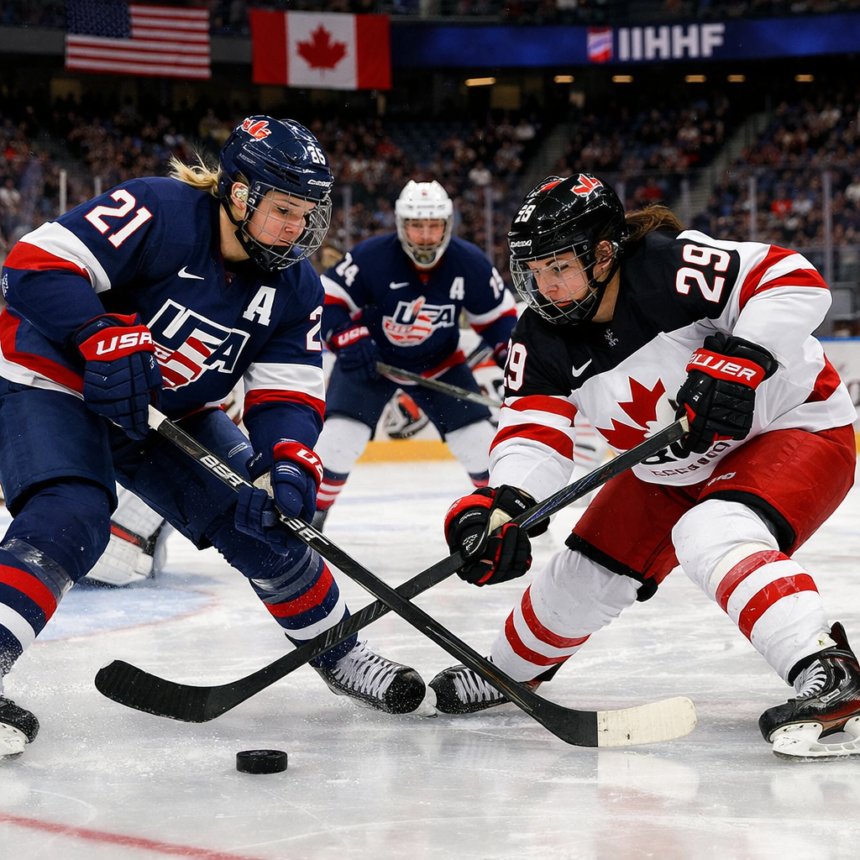
The international sporting calendar rarely produces a conflict as storied and deeply personal as the one found on the ice between the United States and Canada. As the 2026 Milan Cortina Winter Olympics reach their fever pitch, the world’s attention is fixed on the Milano Santagiulia Ice Hockey Arena for the gold medal game scheduled for Thursday, February 19. This contest represents far more than a simple game; it is the eighth time in nine Olympic tournaments that these two titans have faced off for the ultimate prize in the sport. The USA vs. Canada Olympic Women’s Hockey narrative has become the definitive benchmark for excellence in women’s athletics, showcasing a level of skill and parity that few other disciplines can match.
Entering the 2026 final, the dynamic has been further complicated by the emergence of the Professional Women’s Hockey League (PWHL), which has changed how these athletes prepare for international duty. No longer are these rivals training in isolation; many are now teammates in the professional ranks, yet this familiarity has only served to sharpen the competitive edge. When the puck drops in Milan, the professional friendships are set aside in favor of a “blood bath” of physical and tactical warfare. The stakes of this USA vs. Canada Olympic Women’s Hockey duel have never been higher, as both nations seek to define their legacy in this new era of the sport.
The path to the 2026 final has been anything but conventional, particularly for a Canadian squad that has had to fight through adversity and injury. Conversely, the Americans have moved through the tournament with a machine-like efficiency that has left spectators and analysts in awe of their systemic depth. To truly appreciate the magnitude of this USA vs. Canada Olympic Women’s Hockey encounter, one must look past the scores and into the tactical evolutions that have brought these teams to the brink of gold once again.
The Five-Goal Statement: Rewriting History in the Preliminary Round
The defining moment of the tournament thus far occurred on February 10, 2026, when the United States delivered a staggering 5-0 shutout against Canada in their final preliminary game. This result sent shockwaves through the hockey world, as it marked the first time in 41 Olympic meetings that the Canadian women had been held without a goal. The Americans did not just win; they dismantled the Canadian structure using a combination of relentless speed and aggressive puck possession that left their rivals searching for answers.
Hannah Bilka was the standout performer in this historic rout, netting two goals that highlighted the American ability to capitalize on defensive lapses. The scoring began early when Caroline Harvey found the back of the net just 3:45 into the first period, setting a tone of American dominance that lasted the entire sixty minutes. As the game progressed, the Canadian defense struggled to handle the “high-octane” transition play of the U.S. forwards, eventually leading to a goaltending change as the lead swelled.
Canada’s performance was undeniably hampered by the absence of their captain, Marie-Philip Poulin, who was sidelined with a lower-body injury. Without the stabilizing presence of “Captain Clutch,” the Canadians appeared uncharacteristically “sloppy” and unable to effectively clear their own zone. This preliminary USA vs. Canada Olympic Women’s Hockey clash served as a wake-up call for the defending champions, proving that their veteran experience might not be enough to counter the sheer velocity of the modern American system.
The Unstoppable Juggernaut: Analyzing the 31-1 Goal Differential
The statistical profile of the 2026 U.S. Olympic team is nothing short of historic, defined by a 31-1 goal differential across their first six games. Since allowing a single goal in their tournament opener against Czechia, the Americans have reeled off five consecutive shutouts, an Olympic record that has left their opponents feeling mathematically outclassed. This level of defensive perfection is a testament to the tactical discipline instilled by the coaching staff and the individual brilliance of the American blue line.
The American dominance is also a reflection of a successful youth movement that has integrated seven college players into a veteran-heavy core. Players like Abbey Murphy and Laila Edwards have brought a “youthful swagger” to the locker room, complementing the veteran poise of leaders like Hilary Knight. This depth allows the U.S. to roll four high-energy lines, ensuring that their pace never slackens regardless of the game situation. As they prepare for the USA vs. Canada Olympic Women’s Hockey final, the Americans possess the confidence of a team that has truly mastered the modern game.
Team USA 2026 Tournament Performance Metrics
| Round | Opponent | Score | Key Takeaway |
| Preliminary | Czechia | 5-1 | Only goal conceded in tournament |
| Preliminary | Finland | 5-0 | Sanni Ahola faced 50 shots |
| Preliminary | Switzerland | 5-0 | Perfect penalty kill performance |
| Preliminary | Canada | 5-0 | First Olympic shutout of Canada |
| Quarterfinal | Italy | 6-0 | Kendall Coyne Schofield brace |
| Semifinal | Sweden | 5-0 | Clinched 7th gold medal berth |
Resilience of the Maple Leaf: Canada’s Grit and the Poulin Factor
Canada’s journey to the USA vs. Canada Olympic Women’s Hockey final has been a stark contrast to the American cruise, defined instead by “too-close-for-comfort” victories and significant injury scares. After the demoralizing shutout loss to the U.S., the Canadians had to find their rhythm quickly, securing a 5-0 win over Finland to stabilize their standings. However, it was the semifinal match against Switzerland that truly tested Canada’s championship mettle, as they escaped with a narrow 2-1 victory despite outshooting their opponents 46-8.
The undeniable catalyst for Canada’s resurgence has been the return of Marie-Philip Poulin, who proved her “Captain Clutch” moniker once again during the knockout stages. Poulin, despite playing through a lower-body injury, scored both goals in the semifinal to propel her team into their eighth straight Olympic final. In doing so, she broke the all-time Olympic women’s goal-scoring record, now standing at 20 career goals. Her presence on the ice transforms the Canadian power play and provides an emotional anchor for the entire roster.
For Canada to be successful in the USA vs. Canada Olympic Women’s Hockey final, they must rely on this veteran core that possesses a staggering 53 combined world championship gold medals. The Canadian strategy is built on resilience and the ability to thrive in “bloody” physical contests where the margins are razor-thin. They are banking on the fact that the high-pressure environment of a final will favor their experience over the American speed, potentially forcing the younger U.S. players into unforced errors.
While the statistical leaders like Daryl Watts and Sarah Fillier have provided necessary secondary scoring, the focus remains on the “big game” performers. Canada understands that they are the underdogs in this USA vs. Canada Olympic Women’s Hockey rematch, a position they have successfully navigated in the past. By tightening their defensive gaps and leaning on the historic brilliance of Poulin, the Canadians believe they can orchestrate an upset that would rival the most dramatic moments in Olympic history.
Legends at the Zenith: The Duel of Poulin and Knight
The USA vs. Canada Olympic Women’s Hockey final serves as a monumental crossroads for two of the greatest players to ever lace up skates: Marie-Philip Poulin and Hilary Knight. Both captains are competing in their fifth Olympic Games, and both are on the cusp of setting records that may never be broken. Poulin has already claimed the career goal record, but her true goal remains a fourth Olympic gold medal, a feat that would cement her status as the “best player on the planet.”
This individual battle is a microcosm of the entire USA vs. Canada Olympic Women’s Hockey rivalry—a clash of different styles and shared excellence. Poulin’s game is defined by tactical awareness and the uncanny ability to score when the game is on the line, having netted game-winning goals in three separate gold medal finals. Knight, by contrast, uses her size and skating power to overwhelm defenders and create space for her younger, faster teammates like Taylor Heise and Hannah Bilka.
The Wall of Silence: Goaltending and Professional Maturity
Aerin Frankel has been the silent architect of the American success in Milan, putting together one of the most dominant goaltending performances in Olympic history. The 26-year-old debutante has recorded three shutouts in a single tournament, a feat never before achieved in women’s Olympic hockey. Frankel enters the USA vs. Canada Olympic Women’s Hockey final with a 331-minute scoreless streak, a “Wall of Silence” that has effectively neutralized the offensive strategies of every opponent she has faced.
The goaltending matchup is a study in contrasting philosophies: Frankel’s modern, high-energy athleticism versus Desbiens’ calm, technical efficiency. In a game likely to be decided by a single bounce or a late-game power play, the performance of these two netminders will be the ultimate deciding factor. The USA vs. Canada Olympic Women’s Hockey final will likely come down to which goaltender can maintain their composure as the pressure of the gold medal begins to mount.
Professionalism and the PWHL: A New Era for Olympic Preparation
The 2026 Winter Olympics marks the first time that the USA vs. Canada Olympic Women’s Hockey rivalry has been played under the deep influence of the Professional Women’s Hockey League (PWHL). With 39 PWHL players representing the two nations, the level of conditioning and tactical sophistication has reached a new peak. Analysts have noted that the “game-readiness” of the athletes is significantly higher than in previous cycles, as they have spent the months leading up to Milan playing in a high-stakes professional environment.
The PWHL has fostered a unique dynamic where rivals on the international stage are teammates on the professional stage. For example, American stars like Hilary Knight and Canadian standouts like Marie-Philip Poulin are now part of a shared professional ecosystem that promotes the growth of the sport. However, this familiarity has not dulled the intensity of the USA vs. Canada Olympic Women’s Hockey rivalry; if anything, it has sharpened it, as players now have a deeper understanding of each other’s tendencies and weaknesses.
Betting the Ice: Odds, Tactics, and the Final Prediction
As the puck drop approaches, the betting markets have positioned the United States as a “massive” favorite to reclaim the gold medal. Odds from major sportsbooks like FanDuel and Caesars list the American moneyline as high as -410 to -455, implying an 80% probability of victory. This is a significant departure from previous Olympic finals, reflecting the historic dominance the U.S. has shown throughout the 2026 tournament and the 2025 Rivalry Series.
Tactically, the USA vs. Canada Olympic Women’s Hockey final will be won or lost in the neutral zone. In their preliminary victory, the Americans used their superior foot speed to “eliminate the neutral zone,” preventing Canada from establishing their physical forecheck. If the U.S. can maintain this transition speed, they will likely continue to outshoot the Canadians by a significant margin. Canada, however, must focus on “clogging” the lanes and turning the game into a physical war of attrition along the boards.
Looking Beyond Milan: The Future of the Rivalry
Regardless of the result on Thursday, the USA vs. Canada Olympic Women’s Hockey rivalry is entering a new chapter of sustained excellence. The integration of the PWHL and the continued growth of NCAA programs ensure that the talent pool is deeper than ever before. For more on the long-term trajectory of international play, see our related analysis on. While other nations like Czechia and Sweden are making strides, the North American duopoly remains the gold standard for the sport.
The 2026 Games have shown that the rivalry is no longer just about two national teams; it is about the professionalization and global expansion of women’s hockey. The record-breaking attendance and viewership numbers for the USA vs. Canada Olympic Women’s Hockey matches indicate that the public appetite for this level of competition is insatiable. As we look toward the 2030 Games, the foundation laid in Milan will serve as the benchmark for future generations of athletes.