


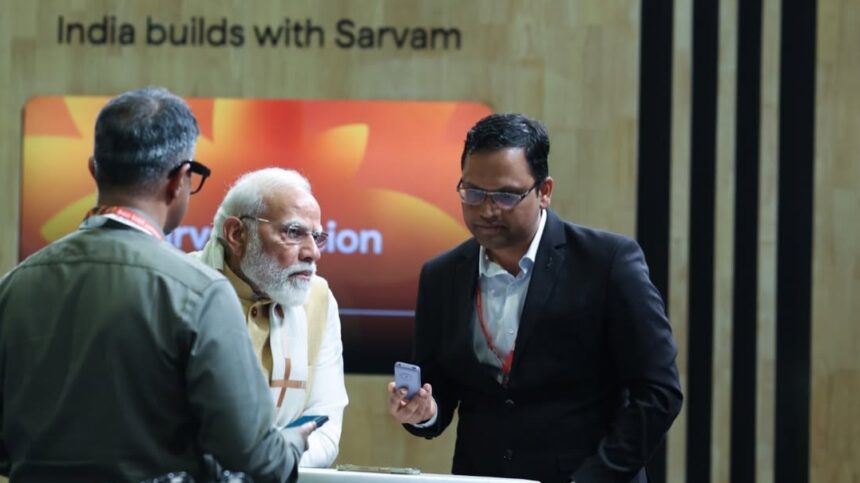
From February 16–20, 2026, New Delhi hosted the historic India AI Impact Summit at Bharat Mandapam. Inaugurated by Prime Minister Narendra Modi, the event gathered global leaders and CEOs to establish ethical AI frameworks, promote Global South interests, and secure over $200 billion in projected tech investments for India.
Full Event Breakdown: From Vision to Action
The India AI Impact Summit 2026 represents a watershed moment for the Global South, marking the first time a major international AI governance forum has been hosted outside the traditional Western tech hubs. Spanning five days across multiple venues including Bharat Mandapam and Sushma Swaraj Bhawan, the summit was structured around three “Sutras”—People, Planet, and Progress—and seven “Chakras” focusing on domains like AI skilling, social inclusion, and sustainable computing.
The event kicked off with a massive “AI Impact Expo,” where more than 840 exhibitors, including startups from across India and 30 other countries, showcased pilot-ready solutions. A significant highlight was the Tata AI Sakhi Immersion Program, where 1,600 rural women from six Indian states demonstrated how they use AI in local dialects to navigate government schemes and market artisanal products.
Key milestones during the week included:
- February 16: Inauguration of the AI Expo and the launch of “Knowledge Compendiums” for AI in Health and Agriculture.
- February 17: Bilateral talks between PM Modi and French President Emmanuel Macron, focusing on a joint “AI Action Plan.”
- February 18: Release of the India AI Governance Guidelines and a white paper on AI for Manufacturing Engineering Technology (AI-MET).
- February 19: The formal Leaders’ Plenary, where the “New Delhi Declaration on Ethical AI” was drafted.
Global & Local Impact: A Shift in the Tech Order
The summit’s impact extends far beyond the walls of the convention center. Locally, it has solidified India’s “AI for All“ mantra. The government announced a massive expansion of its sovereign compute capacity, adding 20,000 GPUs to its existing infrastructure. This move is designed to lower the cost of AI development for Indian startups to as little as ₹65 per hour, effectively democratizing access to high-end technology.
Globally, the summit has positioned India as the “bridge” between the Western tech giants and the Global South. By hosting leaders like Google’s Sundar Pichai and OpenAI’s Sam Altman alongside heads of state from Brazil and African nations, India ensured that the conversation on AI wasn’t just about profit, but about sovereignty and inclusivity. The projected $200 billion investment inflow over the next two years is expected to transform India into a global hub for “Deep Tech” and AI-driven manufacturing.
The Bharat Mandapam in New Delhi serves as the nerve center for the 2026 India AI Impact Summit, hosting over 20 heads of state and 500 global tech leaders.

Official Reactions & Statements
Prime Minister Narendra Modi emphasized the human-centric approach in his keynote address:
“AI should not be a tool for exclusion, but a bridge for inclusion. Our ‘Sutras’ of People, Planet, and Progress ensure that technology serves the last person in the queue first.”
Ashwini Vaishnaw, Union Minister for Electronics and IT, noted that the summit marks the beginning of the “fifth industrial revolution” in India, driven by responsible innovation and substantial infrastructure scaling.
UNESCO representatives at the summit praised India’s leadership in ethical AI, specifically highlighting the “AI Essentials for Judges” brief as a critical step toward protecting human rights in the age of automation.
Tech-Logic: Technical Analysis
The technical backbone of the summit’s success lies in India’s shift toward Sovereign AI Infrastructure. Unlike private-sector dominated models in the US, India’s strategy leverages the ₹10,300+ crore IndiaAI Mission. This mission focuses on a multi-layered stack: hardware (GPU clusters), foundational models (multilingual LLMs like Bhashini), and application layers for public delivery.
The announcement of an additional 20,000 GPUs is not merely about raw power; it is about energy-efficient computing. A dedicated session titled “Smaller Footprint, Bigger Impact” discussed how lightweight AI models can reduce energy consumption by up to 90%. By integrating Carbon Capture Utilisation and Storage (CCUS) with data center operations—supported by a ₹20,000 crore outlay in the latest Union Budget—India is attempting to solve the “AI Energy Paradox.” This logic ensures that as the nation’s compute capacity grows, its carbon footprint remains managed, aligning tech expansion with the “Planet” Sutra.