


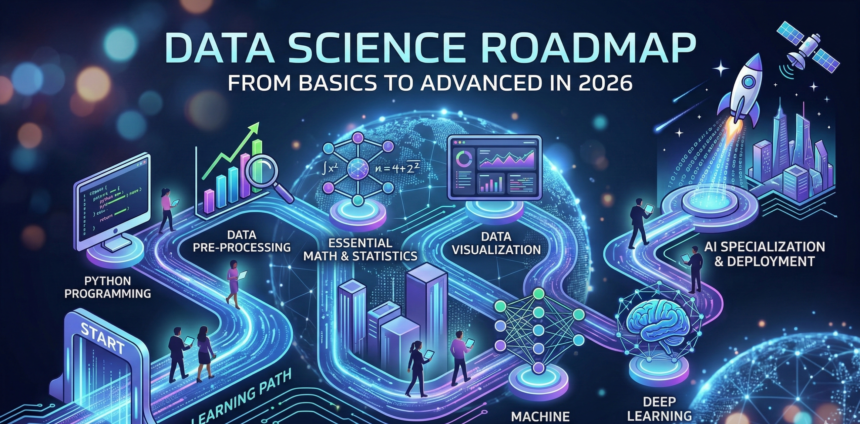
The world has shifted from simply collecting information to demanding intelligent action from it. As we navigate through 2026, the role of a data professional has evolved into a sophisticated blend of mathematical intuition, architectural coding, and creative visualization. Whether you are a student in Varanasi or a professional in Silicon Valley, the path to mastering this field requires a structured approach that moves beyond theory and dives deep into the practical application of Data Science.
The Architecture of Tomorrow: Why Data Science is Non-Negotiable
In the current technological landscape, we are no longer just interacting with software; we are living within an ecosystem powered by Data Science. From the personalized content streams on your favorite entertainment platforms to the autonomous taxis navigating the streets of Dubai, every modern convenience is a product of high-level data processing. For those looking to build a career, understanding that Data Science is the intersection of programming, statistics, and machine learning is the first step toward becoming an industry leader. Visit here Official Python Documentation for Data Science
Foundation First: Mastering the Language of Logic
Once the basics are secure, a professional must master two essential libraries: NumPy and Pandas. These tools are the workhorses of data pre-processing. In the real world, data is messy, inconsistent, and often incomplete. Using Data Science techniques to clean and “wrangle” this data is where most of the hard work happens. NumPy handles the heavy numerical computations, while Pandas provides the structure needed to manipulate large datasets with ease.
The Mathematical Intuition: Logic Over Memorization
There is a common misconception that you need a PhD in Mathematics to succeed in this field. In reality, a solid grasp of high-school-level math is often enough to get started, provided you focus on the right areas. To truly understand Data Science, you must develop an intuition for Statistics and Probability. Concepts like mean, variance, and standard deviation aren’t just formulas; they are the tools you use to describe the “behavior” of your data.
Visual Storytelling: The Art of Data Visualization
A data scientist’s job is not just to find insights but to communicate them. This is where Data Visualization becomes a critical skill. By using libraries like Matplotlib and Seaborn, you can turn abstract numbers into compelling visual narratives. In 2026, being able to present a clear trend through a heatmap or a scatter plot is often more valuable than the raw code itself. It allows stakeholders to see the “why” behind your Data Science conclusions.
For those targeting specific business intelligence roles, tools like Power BI and Tableau are excellent additions to your toolkit. These platforms allow you to create interactive dashboards that update in real-time. In the professional world of Data Science, your ability to tell a story with data determines how much impact your work will have on the organization’s bottom line.
The 2026 Data Science “Fast-Track” Sheet
| Pillar | Phase | Core Tools & Skills | Daily Goal (2-Min Task) |
| 1. The Foundation | Programming & Cleaning | Python, Pandas, NumPy | Write one script to clean a “messy” CSV file. |
| 2. The Logic | Math & Stats | Probability, Linear Algebra, Stats | Calculate Mean/Variance of a real dataset. |
| 3. The Engine | Machine Learning (ML) | Scikit-Learn, Regression, Trees | Build a simple model to predict house prices. |
| 4. The Future | Deep Learning & Deploy | PyTorch, SQL, GitHub | Upload one project to GitHub for recruiters. |
Strategic Deployment: From Local Code to Global Impact
The secret to long-term success in Data Science is specialization. Whether you choose to focus on Healthcare, Fintech, or Biotech, becoming a domain expert makes you indispensable. By combining your technical skills with specific industry knowledge, you create a “moat” around your career that is difficult for others to cross. The future belongs to those who can bridge the gap between complex algorithms and real-world problems. you Can Exploring our guide on AIML RoadMap.
Frequently Asked Questions (FAQs)
Q1: How long does it take to learn Data Science from scratch in 2026? A1: For a student or professional dedicated to the craft, it typically takes between four to six months of consistent study. This timeframe assumes you are spending 3-4 hours daily focusing on Python, statistics, and machine learning projects to build a robust portfolio.
Q2: Do I need a Computer Science degree to become a Data Scientist? A2: While a degree in CSE provides a strong foundation, it is not a strict requirement. In 2026, recruiters value “proof of work” over certificates. Having a GitHub repository filled with unique projects and a strong grasp of practical Data Science applications is often enough to land a high-paying role.
Q3: Is Deep Learning mandatory for all Data Science roles? A3: While basic data analyst roles may only require machine learning, most “Data Scientist” positions in 2026 expect familiarity with Deep Learning. As AI becomes more integrated into every industry, knowing how to work with neural networks gives you a significant edge in the job market.