

The global digital economy is undergoing a structural “Efficiency Reset,” with How to start e-Commerce Business becoming the primary focal point for retail investors. India’s market specifically is projected to hit $170 billion by 2030. Key players like Amazon and Flipkart are now competing with high-speed “Quick Commerce” and AI-driven D2C brands, signaling an immediate market shift toward automated, hyper-local fulfillment.
Competitive Advantage & Risk Assessment
The primary competitive advantage for those learning How to start e-Commerce Business today lies in “Market Share” capture within Tier-II and Tier-III cities. While “Barriers to Entry” have lowered due to no-code SaaS platforms, the risk of “Commodity Drift” is at an all-time high . According to recent data from Bloomberg, the shift toward automated fulfillment is a non-negotiable factor for e-commerce longevity.
Below is the executive-level sequence for market entry.
Phase 1: Strategic Foundation
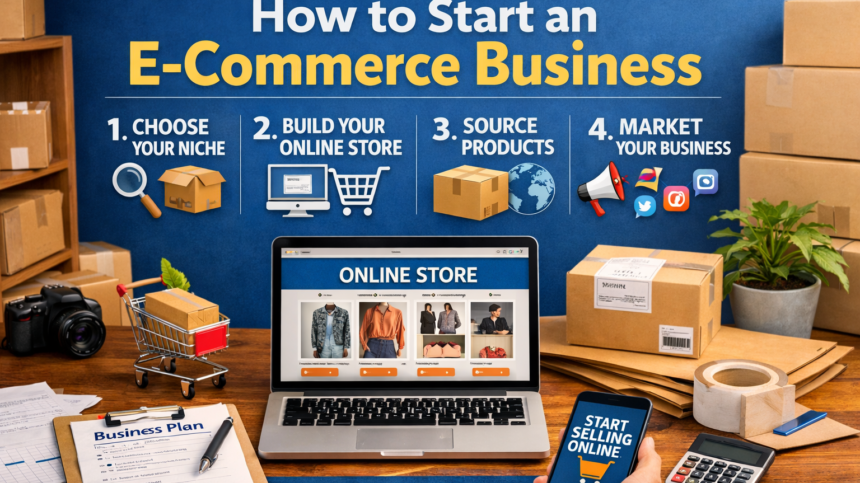
- Niche Selection & Validation: Identify a high-growth sector (e.g., eco-friendly lifestyle, AI devices, or sustainable health). Validate demand using search volume of How to start e-Commerce Business.
- Product Sourcing Model: Determine your supply logic.
- White Labeling: Rebranding generic products for instant Dominance.
- Dropshipping: Minimal upfront capital with external fulfillment.
- Manufacturing: Proprietary production to build a unique economic “moat.”
- Business Intelligence (The Plan): Draft a roadmap focusing on financial projections, target demographics, and the Unique Value Proposition (UVP) that differentiates you from mass-market competitors.
Phase 2: Legal & Infrastructure
- Corporate Registration: Establish your legal entity. In India, a GST Registration is non-negotiable for onboarding with major marketplaces (Amazon, Flipkart) or payment gateways.
- Brand Identity: Secure your digital real estate. Register a short, memorable domain name and apply for a Trademark to protect your brand intellectual property.
- Storefront Deployment: Select a platform based on technical needs.
- WooCommerce: Best for content-heavy SEO integration.
- Shopify: Best for rapid deployment and managed security.
- Marketplaces: Best for immediate traffic with higher commission costs.
Phase 3: Operational Logistics
- Payment Architecture: Integrate a reliable payment gateway (e.g., Razorpay, Stripe) to handle credit/debit, UPI, and digital wallets securely.
- Supply Chain Setup: Partner with specialized logistics providers (e.g., Shiprocket, Delhivery) to manage shipping, Cash on Delivery (COD), and return processing.
- Product Cataloging: Create high-density, SEO-optimized listings. Use high-resolution imagery and keyword-rich descriptions to maximize organic “Market Share.”
Phase 4: Market Penetration
- SEO & Automation: Implement technical SEO and email automation (for cart recovery) to sustain consistent Scalability without manual intervention.eo now accounts for 40% of all social-based transactions.
- Omnichannel Marketing: Deploy a “Social-First” strategy using short-form video (Reels/Shorts) to drive discovery.
Strategic Comparison Table
| Feature | Custom Tech Stack | WooCommerce/SaaS | Marketplace-Only |
| Price-to-Performance | Low (High Capex) | High (Optimal for 2026) | Medium (Commission Heavy) |
| Scalability | Unlimited | Modular & Rapid | Restricted by Platform |
| Market Reach | Full SEO Control | Omnichannel Synergy | High Internal Traffic |
Financial Logic & Future Forecast
The financial logic of How to start e-Commerce Business has shifted from volume-chasing to “Unit Economic Discipline.” Investors are now prioritizing “Agentic Payment Protocols,” where AI agents execute purchases autonomously.
A 300-word deep dive into the 2026 revenue model highlights the “Subscription-as-a-Service” (SaaS) integration within retail. By embedding recurring billing, businesses stabilize cash flow against seasonal Volatility. As firms pivot toward high-margin digital goods, staying updated with evolving Business Category Insights on Savitimes.com is critical for maintaining market share.
Competitive Advantage & Risk Assessment
The primary competitive advantage for those learning How to start e-Commerce Business today lies in “Market Share” capture within Tier-II and Tier-III cities. While “Barriers to Entry” have lowered due to no-code SaaS platforms, the risk of “Commodity Drift” is at an all-time high. Businesses must leverage “White Labeling” and “First-Party Data” to build a defensible economic moat. According to recent data from Bloomberg, the shift toward automated fulfillment is a non-negotiable factor for e-commerce longevity.
Business FAQs
- Is it a good investment? Absolutely. With a 14.1% CAGR and a $200 billion B2B opportunity by 2030, the ROI on How to start e-Commerce Business remains among the highest in the digital sector.
- Who is the target demographic? The “Mobile-First” generation in emerging markets and “AI Shopping Agents” that prioritize structured, machine-readable product data.
- What is the 5-year outlook? Total integration of AR/VR “Virtual Showrooms” and a shift toward “Social-Native Checkout” where the traditional website redirect becomes obsolete.