

The demand for AI PM Skills Product Managers in 2026 is at an all-time high as companies pivot from basic API calls to autonomous agentic systems. Average global salaries for Lead AI PMs range from $180,000 to $340,000. With an 85% increase in “AI-Native” job postings, the “Future-Proof” rating for 2026 is 9.8/10.
Introduction
The tech landscape has shifted from “AI-added” to “AI-first,” creating a massive opportunity gap for leaders who can bridge the divide between messy human problems and probabilistic machine outputs. Mastering the AI PM Skills is now the primary differentiator for professionals looking to exit stagnant traditional roles and enter high-growth ecosystems.
The Skill-Stacking Advantage
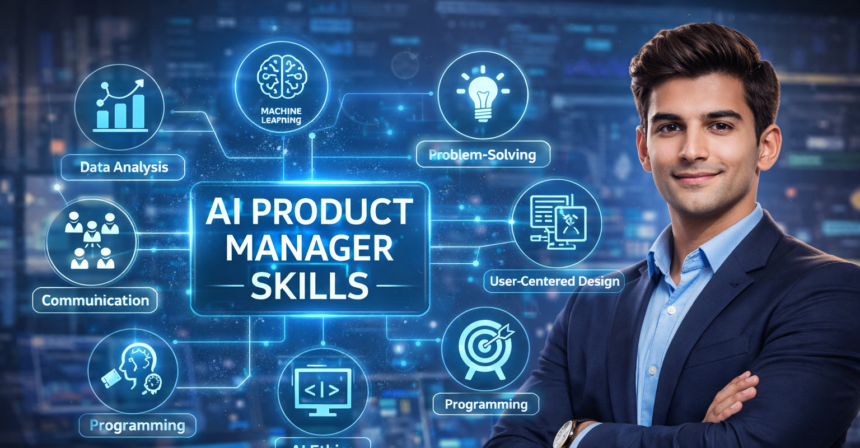
Success in this role requires a strategic “Skill-Stack” that balances technical depth with high-level business intuition. By focusing on the AI PM Skills, candidates contrast hard technical skills—like understanding RAG (Retrieval-Augmented Generation), vector databases, and model evals—with durable skills such as critical thinking and ethical reasoning. While mastering the OCI or AWS AI stack provides the necessary infrastructure knowledge, the ability to define “what good looks like” for a probabilistic system is a durable skill that cannot be automated.
Career Progression & Salary Table
The following 5-year trajectory outlines the transition from traditional management to elite AI leadership based on current 2026 benchmarks.
| Career Level | Experience | Role Title | Key Certifications | Salary (USD) |
| Entry | 0-2 Years | Associate AI PM | AWS AI Practitioner, PM Fundamentals | $110k – $145k |
| Mid-Level | 3-5 Years | AI Product Manager | Google ML Engineer, Azure AI Engineer | $160k – $210k |
| Senior | 6-8 Years | Sr. AI Product Lead | Advanced MLOps, GenAI Academy Cert | $220k – $290k |
| Lead/Exec | 9+ Years | VP of AI Product | AI Governance (AIGP), Strategy Certs | $310k – $450k+ |
The Portfolio vs. Resume Shift
In 2026, a static resume is a secondary validator compared to a live, functional portfolio. To prove your mastery of the AI PM Skills, you must ship “Tiny AI Products”—such as a RAG-powered knowledge search or a sentiment-driven feedback analyzer—rather than just listing certifications. These projects demonstrate to hiring teams that you understand how prompts break in production and how latency affects user experience. Your portfolio should include a “decision log” that explains the architectural trade-offs you made, proving you have moved beyond theory into the practical reality of shipping production-grade AI systems. Explore more about our Career Growth strategies for the 2026 market. Read the latest research on AI in Education by MIT News.
The AI-Co-Pilot Reality
The day-to-day workflow of an AI PM in 2026 is fundamentally transformed by AI Co-Pilots like Gemini and GitHub Copilot. These tools allow a PM to work 10x faster by automating the creation of PRDs, user stories, and initial system prompts, shifting the PM’s focus from “writing” to “orchestrating.” An AI PM uses these co-pilots to rapidly prototype features and run simulations on edge cases that would have previously taken weeks to identify.
By integrating the AI PM Skills with co-pilot efficiency, you can manage the full feedback loop—including post-launch monitoring and automated evals—with minimal manual intervention. This reality means you are no longer just a feature owner; you are a system designer who uses AI to audit AI.
3 Career FAQs
What is the fastest way to break into this field?
The fastest route is to master PM fundamentals for 8 weeks, then ship one real-world AI project, such as an LLM-based resume assistant, to prove your end-to-end product intuition.
Is a degree required?
While a technical background helps, 2026 hiring trends show that 55% of AI PMs are hired based on their portfolio of shipped AI products and specialized certifications rather than a Master’s degree.
How to negotiate a remote-work salary?
Highlight your ability to use AI Co-pilots to maintain 10x productivity and demonstrate your framework for managing “Responsible AI” constraints independently from a remote environment.