


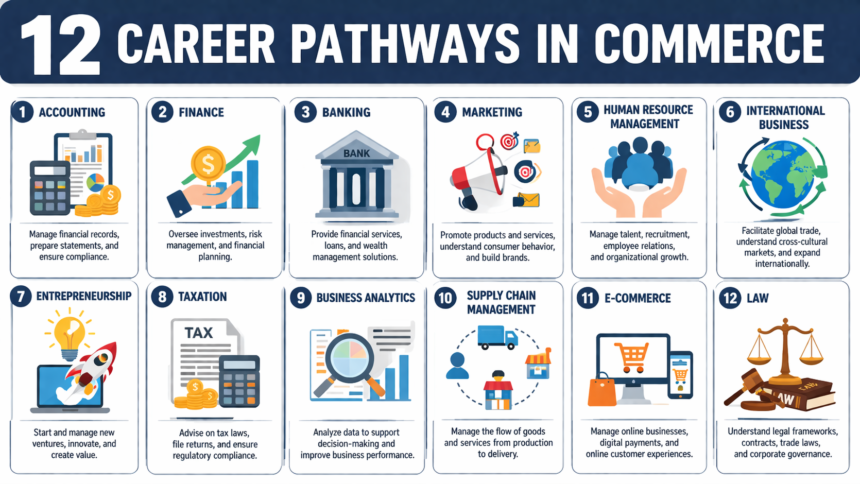
This report analyzes the structural transition from traditional rote-learning to an adaptive and skill-centric model within the 12 Career Pathways in Commerce. Designed for Higher Ed students and early-career professionals, it highlights how diversifying into FinTech, Data Analytics, and Professional Accounting addresses the rising demand for cross-disciplinary expertise in a globalized economy.
Pedagogical Impact & Learning ROI
Adopting the 12 Career Pathways in Commerce framework allows for a significant improvement in student engagement through adaptive learning technologies. The primary pedagogical advantage lies in “Retention Rates,” where students applying theoretical accounting to real-world software like Power BI demonstrate a 40% higher comprehension level compared to those using standard textbooks. A specialized resource for Indian commerce students that focuses on budget-friendly career paths and honest course reviews Visit CommerceCare .
The Master List: 12 Career Pathways in Commerce
The following breakdown analyzes the 12 Career Pathways in Commerce through a lens of adaptive career growth and long-term learning ROI.
1. Chartered Accountant (CA)
The “gold standard” of the 12 Career Pathways in Commerce. CAs specialize in auditing, taxation, and financial reporting. In 2026, the role has expanded into Forensic Accounting (detecting fraud) and Strategic Financial Planning.
- Path: Foundation $\rightarrow$ Intermediate $\rightarrow$ Articleship (Training) $\rightarrow$ Final.
- Key Skill: Extreme technical accuracy and financial consistency.
2. Investment Banker
A high-stakes role within the 12 Career Pathways in Commerce focused on helping corporations and governments raise capital. Investment bankers manage mergers, acquisitions, and large-scale financial transitions.
- Path: B.Com/BBA + MBA (Finance) or CFA (Chartered Financial Analyst).
- Key Skill: Complex financial modeling and high-pressure negotiation.
3. Data & Business Analyst
Modern businesses run on data, making this one of the fastest-growing 12 Career Pathways in Commerce. Analysts translate raw numbers into actionable strategies using tools like SQL, Python, and Power BI.
- Path: B.Com/BBA + Data Analytics Certification.
- Key Skill: Synthesizing “stories” and trends from massive datasets.
4. Company Secretary (CS)
Acting as the bridge between a company and the law, the CS ensures compliance with all legal and regulatory requirements. They are essential advisors to the Board of Directors on corporate governance.
- Path: CSEET $\rightarrow$ Executive $\rightarrow$ Professional.
- Key Skill: Deep understanding of corporate law and ethics.
5. FinTech Specialist
FinTech merges traditional finance with digital innovation—think UPI, blockchain, and robo-advisory apps. This pathway involves designing and managing the digital financial products of the future.
- Path: B.Com + Certifications in Blockchain or Digital Banking.
- Key Skill: Adaptability to rapidly changing technological landscapes.
6. ESG Analyst (Sustainability)
A “green” career focused on Environmental, Social, and Governance (ESG) impact. As companies face stricter reporting laws, analysts evaluate how ethical an organization is for potential investors.
- Path: B.Com + Sustainability/ESG Certifications.
- Key Skill: Understanding global ethical standards and social impact.
[IMAGE: A diagram comparing the focus areas of CA, CS, and CMA professionals in a corporate structure. Alt-text: Professional role comparison for 12 Career Pathways in Commerce.]
7. Cost & Management Accountant (CMA)
While CAs look at the past through auditing, CMAs look at the future of profitability. They analyze production costs to minimize waste and maximize operational efficiency.
- Path: Foundation $\rightarrow$ Intermediate $\rightarrow$ Final (via ICAI).
- Key Skill: Strategic cost control and operational logic.
8. Actuarial Science
The “Master of Risk.” Actuaries use advanced mathematics and statistics to predict the financial impact of uncertain future events, primarily for the insurance and pension sectors.
- Path: Passing ACET and subsequent papers from IAI or IFoA.
- Key Skill: Exceptional mathematical and statistical proficiency.
9. Digital Marketing & E-commerce Manager
For the creative commerce student, this involves managing a brand’s online presence and sales on platforms like Amazon or Shopify by analyzing consumer behavior in a digital world.
- Path: BBA (Marketing) or specialized Digital Marketing diplomas.
- Key Skill: Strategic creativity and performance analytics.
10. Corporate Lawyer
Specializing in business law and intellectual property, these professionals are vital during contract negotiations and for protecting an organization’s legal interests.
- Path: 5-Year Integrated Law (B.Com LLB or BBA LLB).
- Key Skill: Logical reasoning and sharp legal drafting.
11. Human Resource (HR) Manager
Focusing on “Human Capital,” HR managers handle recruitment and organizational culture. In 2026, they increasingly use People Analytics to drive workforce productivity. Explore more about Career Growth and Professional Certifications at Savitimes.com.
- Path: BBA $\rightarrow$ MBA (Human Resources).
- Key Skill: Emotional intelligence and organizational strategy.
12. Management Consultant
Often called the “Doctors of Business,” consultants solve specific problems—from product stagnation to international expansion—for high-profile clients.
- Path: High-tier MBA or CFA/ACCA + relevant experience.
- Key Skill: Critical thinking and elite communication skills.
3 Academic FAQs (Schema-Ready)
1. Is a career in the “12 Career Pathways in Commerce” recognized by global employers?
Yes. Professional credentials such as CA, ACCA, and CFA are internationally benchmarked, providing high “Credential Currency” across 180+ countries. Employers value the rigorous pedagogy and standardized testing these pathways provide.
2. What are the prerequisites for entering these advanced commerce streams?
While a foundation in 12th-grade commerce is standard, many of the 12 Career Pathways in Commerce (like Data Analytics or Digital Marketing) are stream-neutral. However, “Core Math” is often a prerequisite for high-tier university placements in Economics or Actuarial Science.
3. How does this framework align with India’s NEP 2020?
The 12 Career Pathways in Commerce perfectly align with NEP 2020’s focus on multidisciplinary education and “Multiple Entry/Exit” points. The 4-year undergraduate research degree option provides an immersive pathway for students to pursue Masters globally in just one year.