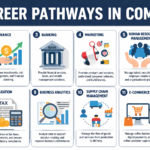



The transition into a data-driven career in 2026 requires more than just a passing familiarity with spreadsheets. To bridge the widening skill gap in the Indian market—where nearly 20 lakh vacancies are projected—learners must move toward an adaptive pedagogy. The primary learning objective of this report is to outline the Data Analyst required for professional readiness in e-commerce, healthcare, and supply chain management.
Responsibilities of a Data Analyst
AI Collaboration: Using Large Language Models (LLMs) and Copilots to write boilerplate code, allowing the analyst to focus on higher-order “Retention Rates” and “Accessibility” of information.
Data Synthesis & Cleaning: Gathering fragmented data from cloud-native platforms and using AI tools to automate the cleaning process. This ensures “Data Accuracy,” which is the foundation of the Data Analyst.
Strategic Problem Solving: Instead of just “crunching numbers,” analysts identify which business problems (like customer churn or supply chain delays) require intervention.
Insight Generation & Storytelling: Translating complex SQL queries and Python scripts into a narrative that non-technical stakeholders (CEOs, Marketing Managers) can understand.
Market Competition: The 2026 Landscape
The current market is characterized by a “competency paradox.” While world-wide vacancies for data analytics have reached 21.5 million, many applicants remain unemployed because they follow outdated roadmaps. Competition is no longer just about who knows the most tools, but who can best integrate AI into their workflow to increase ROI and accessibility. To stand out, an applicant must demonstrate the Data Analyst through a portfolio that solves real-world business problems. For more information on career paths, explore our Career Growth resources. For global standards on digital literacy and the future of work, refer to the UNESCO Institute for Statistics.
The 2026 Data Analyst Process: Mastering the 12 Analytical Credentials
To bridge the modern skill gap, becoming a data analyst requires a 4-to-8-month immersive journey. This pedagogical process transitions from foundational logic to AI-augmented technical execution.
Portfolio Synthesis: Develop 10–12 unique projects documenting your business logic, ensuring your Data Analyst are visible to recruiters.
Mathematical Foundations: Master the Data Analyst of statistics, including probability, hypothesis testing, and standard deviation to understand data behavior.
Spreadsheet Mastery: Use Excel/Google Sheets for intermediate-to-advanced functions like Pivot Tables and XLOOKUP to facilitate rapid data cleaning.
Database Communication: Learn SQL (Structured Query Language) to interact with large-scale corporate databases using joins and window functions.
Programming & AI: Apply Python libraries (Pandas, NumPy) and use AI “Prompt Engineering” to automate repetitive cleaning tasks and increase ROI.
Data Visualization: Synthesize insights through PowerBI or Tableau to create interactive dashboards that solve specific business problems.
Annual Income for this role
| Experience Level | Annual Package Range (INR) | Primary Skill Requirement |
| Internship / Entry | ₹2.5 Lakh – ₹4 Lakh | Basic Statistics & Excel |
| Junior (0–2 Years) | ₹5 Lakh – ₹8 Lakh | 12 Analytical Credentials (SQL/Python) |
| Mid-Level (2–5 Years) | ₹9 Lakh – ₹15 Lakh | Machine Learning & Advanced BI |
| Senior (5+ Years) | ₹15 Lakh – ₹25 Lakh+ | Strategic Leadership & Big Data |
Market Dynamics & Compensation ROI
The 2026 landscape shows that candidates who effectively integrate AI into their workflow—a core component of the Data Analyst—often negotiate 20% higher starting salaries. This “AI-Premium” is due to the increased efficiency and reduced “Time-to-Insight” these analysts provide to their employers. While the base package for a fresher typically ranges between 5 to 8 LPA, those who specialize in niche domains like healthcare or e-commerce can see even steeper growth trajectories.
Academic FAQs
- Is this roadmap recognized by global employers? Yes, the Data Analyst are designed to meet the technical standards of 2026, where “Credential Portfolios” are valued over static degrees.
- How does this align with the NEP 2020? The focus on vocational skill-building and digital literacy directly supports the Indian National Education Policy’s goal of creating a “Job-Ready” workforce.
- What are the English communication requirements? In data analysis, being able to explain “Insights” to global stakeholders is as critical as the code itself; hence, language proficiency is a core part of the pedagogy.