


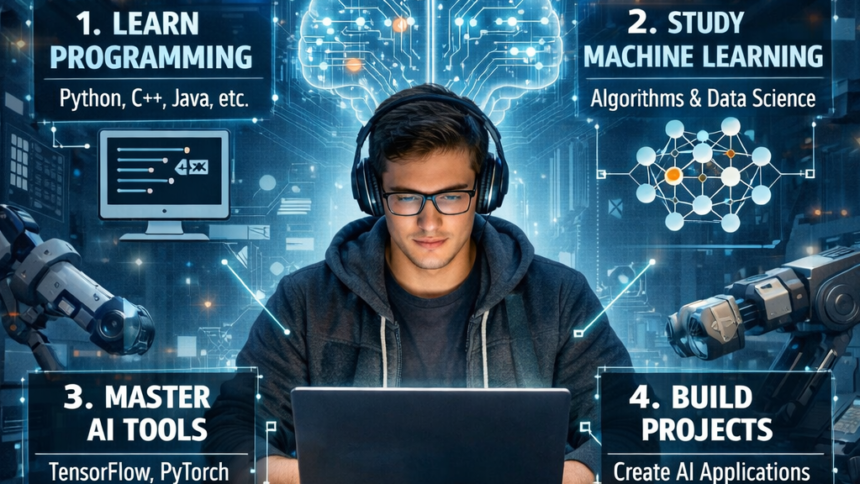
The technological landscape of 2026 has turned the dream of working in Artificial Intelligence into a practical reality for thousands of students and professionals. As we navigate through a world where Face ID, personalized social media feeds, and autonomous traffic predictions are part of our daily routine, the demand for the specialized AI Engineer has reached an all-time high. With over 34,000 active job openings currently listed on LinkedIn, the opportunity to transition into this lucrative field is no longer restricted to those with elite research backgrounds.
Global Impact: How Artificial Intelligence is Reshaping the World
On a consumer level, the work of an AI Engineer has made daily life more seamless than ever before. Real-time language translation has broken down international communication barriers, while AI-driven logistics have optimized global supply chains to reduce waste. This global integration means that the skills you acquire today are universally transferable, allowing an AI Engineer to find high-impact opportunities in virtually any country or industry that values data-driven decision-making and automated intelligence.
Career Horizons: Diverse Opportunities After Mastering the Roadmap
Completing the 2026 roadmap opens a vast array of career paths that go far beyond a single job title. While many start as a Junior AI Engineer, the skills acquired allow for specialization into roles such as a Machine Learning Operations (MLOps) Engineer, who focuses on the deployment and scaling of models. Others may find their calling as a Computer Vision Specialist or a Natural Language Processing (NLP) Researcher, working specifically on how machines see the world or understand human speech and text.
Exploring Deep Learning and Large Language Models
As you progress into the advanced stages of the roadmap, the focus shifts toward neural networks and their intricate architectures. An AI Engineer in 2026 must be comfortable working with Convolutional Neural Networks (CNN) for image recognition and Recurrent Neural Networks (RNN) for sequential data. Furthermore, the rise of Generative AI has made it mandatory to understand Generative Adversarial Networks (GANs), which use a generator-discriminator network to create hyper-realistic synthetic data and art. Click here to view our guide on building the perfect technical resume.
Building Your Proof of Work and Industry Deployment
A theoretical understanding is worth very little in 2026 without a portfolio of real-world projects to back it up. A prospective AI Engineer should aim to complete at least three to four significant projects, such as a fake news detection bot or a text summarization tool using Transformer architectures. Deploying these projects on cloud platforms like AWS, Azure, or Google Cloud is essential to prove that you can handle the engineering side of the “AI Engineer” title, rather than just the mathematical side. For more official documentation, visit the Python Software Foundation.
Frequently Asked Questions (FAQs)
Q1: What is the average salary for a fresher AI Engineer in 2026? Currently, a fresher AI Engineer who possesses strong skills in Python, machine learning, and project deployment can expect a salary package in the range of 6 LPA to 12 LPA. This varies based on the company size and the complexity of the projects showcased in the candidate’s portfolio, with high-growth startups often offering competitive equity in addition to base pay.
Q2: Which library should I learn first: PyTorch or TensorFlow? For those following the 2026 roadmap, it is highly recommended to start with PyTorch. It is widely considered more beginner-friendly and is the preferred framework for academic research. Once you have a firm grasp of neural networks in PyTorch, you should eventually learn TensorFlow, as it remains a dominant force for industry-specific, large-scale deployments in corporate environments.
Q3: Can I transition into AI Engineering from a non-technical background? Yes, you can certainly become an AI Engineer regardless of your background, provided you are willing to commit to five to six months of dedicated learning. The key is to focus on the “learner mindset” and spend at least three to four hours daily mastering the fundamentals of Python and math before moving on to building the real-world projects that recruiters prioritize over traditional degrees.