


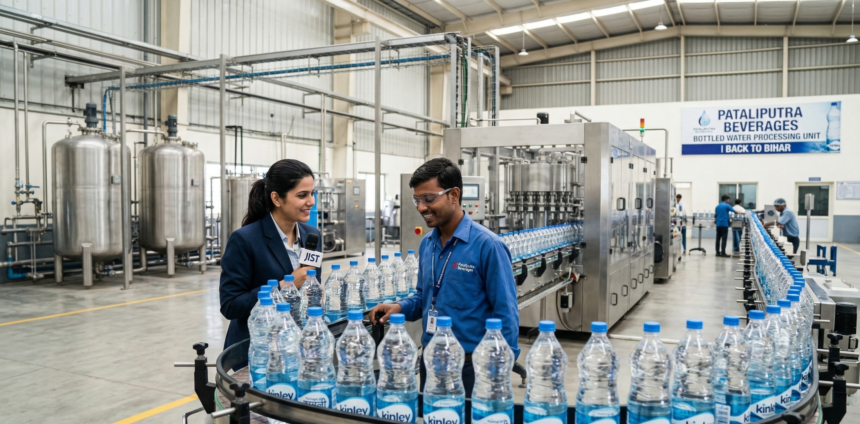
The dusty roads of Bihar are often portrayed through a lens of stagnation, yet a quiet industrial surge is currently redefining the state’s economic identity. Beyond the political rallies and the socio-economic debates lies the hum of high-tech machinery at Pataliputra Beverages. This facility isn’t just a factory; it is a symbol of the Bihar Water Factory Success story that is drawing workers back from distant industrial hubs like Punjab. As you hold a standard ₹20 water bottle, you are holding the end product of a sophisticated chemical and mechanical ballet designed to ensure every drop is pure, safe, and life-sustaining.
The journey begins deep beneath the earth, where Bihar Water Factory Success is extracted via high-capacity borewells. Unlike the water in a household bucket that turns green with algae after a few days, this source water undergoes an immediate transformation. Specialists at the plant introduce controlled doses of chlorine to neutralize microbial threats. This “dosing” process ensures that microorganisms, which typically cause spoilage or illness, are rendered completely inactive before the water ever touches a filter. It is the first line of defense in a multi-stage security protocol that guarantees a shelf life of up to one year . For more information you can visit here : industrial policies in Bihar.
The Science of Purity: From Turbidity to Total Dissolved Solids
Once the Bihar Water Factory Success , water is chemically stabilized, it moves into the Water Treatment Plant (WTP) area. Here, the focus shifts to physical clarity, or what experts call “turbidity.” The water passes through Pressure Sand Filters (PSF) and Activated Carbon Filters (ACF) to strip away yellowness and suspended particles. These filters utilize different granule sizes to absorb residual chlorine and organic matter, ensuring the liquid is as transparent as glass. This stage is crucial because it prepares the water for the most intensive phase of purification: the industrial-scale Reverse Osmosis (RO) system.
Engineering the Vessel: The Magic of Preforms and Molds
Water is only half the story; the container is an engineering marvel in itself. The factory uses “preforms”—small, thick tubes of plastic—which are heated and then subjected to high-pressure air inside specialized molds. This “blowing” process expands the plastic into the familiar bottle shape at a staggering speed of 250 bottles per minute. This synchronized operation ensures that the bottle is created, washed, filled, and capped in a continuous, sterile loop. The precision is so high that even a slight deviation in the water level results in an automatic rejection by the light inspectors.
The human element remains the heartbeat of this automated environment. Workers like Shivakant Kumar, who previously worked in Ludhiana, have returned to their roots because the Bihar Water Factory Success offers more than just a paycheck; it offers proximity to home. The facility operates on a strict 20-minute rotation for light inspectors to prevent eye strain and maintain 100% accuracy. This focus on employee welfare and safety is a cornerstone of the plant’s philosophy, proving that Bihar can compete with national industrial standards while fostering local talent and reversing the trend of forced migration. For Real Ministry of Food Processing Industries.
Quality Over Everything: The Final Dispatch to the Masses
The director of the facility, Shobhit, emphasizes that while the brand might be global, the execution is entirely “Desi.” From the electricity to the manpower, the operation is a localized engine of growth. By maintaining high ratings in quality, safety, and health, the factory has become a profitable model of sustainable industry. As the trucks roll out of the 3.16-acre campus, they carry more than just water; they carry the pride of a changing Bihar.