


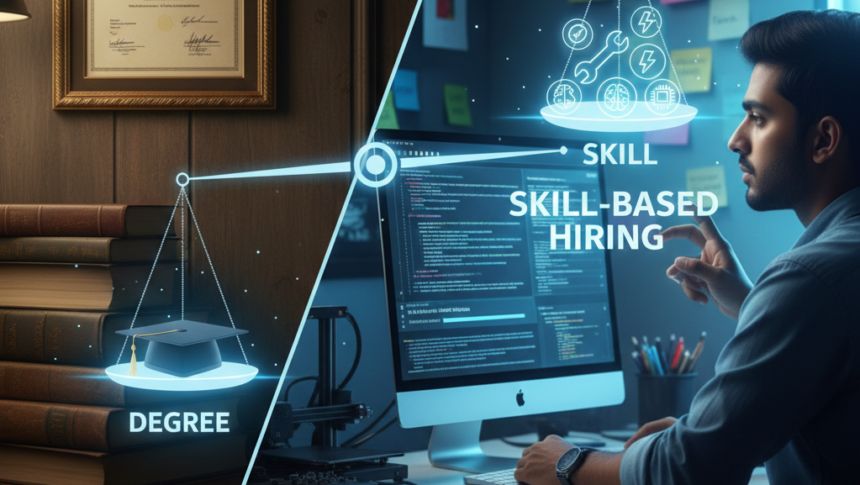
This tutorial analyzes the structural shift in India’s job market from traditional academic validation to “Skill-Based Hiring.” We explore the logic of why 45% of graduates remain unemployable and provide a strategic implementation plan to bridge the gap between holding a piece of paper and securing a high-value career.
For generations, the Indian household has followed a singular, unwritten law: obtain a university certificate, and your life is set. We have all seen the proud father hanging a 4-year B.Tech certificate on the living room wall, believing it to be a golden ticket to a permanent job. However, a silent and devastating shift has occurred in the national landscape. Today, that framed paper is increasingly becoming a decorative relic rather than a professional gateway. Recent data suggests that we are witnessing the Degree vs Skill Reality in its most brutal form, where more than half of the country’s graduates are deemed completely unfit for the roles they applied for.
The Commodification of Education and the Loss of Social Trust
One of the primary reasons the Degree vs Skill Reality has become so skewed is the sheer inflation of educational institutions. When any product is in oversupply, its value naturally plummets. In India, private colleges have sprouted in every corner, often prioritizing enrollment fees over academic rigor. When a student can obtain a Bachelor of Computer Applications without ever writing a line of code, the “social trust” in that evaluation process vanishes. Employers are no longer convinced that a certificate represents wisdom or analytical capability; instead, they see it as a receipt for fees paid over four years. Read the Indian Skill Report 2025 for detailed employability data.
The Rise of the Skill-Based Economy: Wisdom vs Automation
We are entering a phase where the language of the workplace is no longer “What did you study?” but “What can you do?” Modern HR departments have shifted toward skill-based hiring, where a candidate’s portfolio and practical certifications carry more weight than their college pedigree. Reports indicate that a staggering 99% of employers in India are now adopting this methodology. This transition is a double-edged sword; while it democratizes opportunities for those who cannot afford expensive education, it also signals a dangerous trend where “skills” are replacing “wisdom.” A degree was meant to build a person’s character and analytical depth, but in the current Degree vs Skill Reality, short-term vocational fixes are winning.
Technical Career Analysis Table
| Step | Goal | Tool/Action |
| Step 1 | Identity | Personality Tests (MBTI/Big Five) |
| Step 2 | Opportunity | Industry Trend Reports (WEF Future of Jobs) |
| Step 3 | Validation | Networking & Short Certifications |
| Step 4 | Execution | Specialized Degree + Soft Skill Stacking |
Frequently Asked Questions (FAQ)
Q1: Is a B.Tech degree still relevant in India given the current unemployment rates? While B.Tech graduates still have a higher employability rate (around 71%) compared to other streams, the degree alone is no longer a guarantee of a job. Success in the current Degree vs Skill Reality depends on whether the student has supplemented their degree with industry-relevant certifications in coding, data science, or specialized engineering tools.
Q2: Why are Indian employers prioritizing skills over university degrees? Employers have lost faith in the “examination rigor” of many Indian universities. Because many colleges grant degrees without ensuring the student has mastered the subject, HR departments now use independent skill tests and certifications (like those from Coursera or LinkedIn) to verify a candidate’s actual capability.
Q3: How can a student bridge the gap between their degree and market requirements? To thrive in the Degree vs Skill Reality, students should focus on “Skill-Based Portfolios.” This includes taking short-term technical courses, participating in internships, and working on real-world projects that demonstrate their “wisdom” and “application” rather than just their ability to pass a theoretical university exam.