


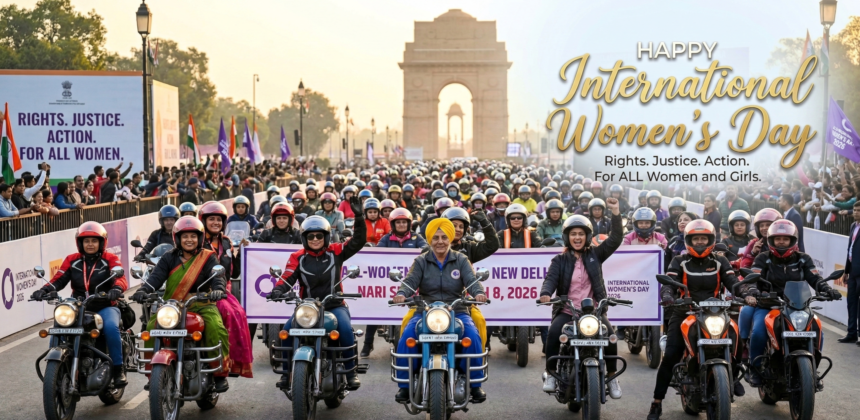
The dawn of March 8, 2026, carried a global vibration that felt fundamentally different from years past. As nations unified under the International Women’s Day 2026 mandate, the air was thick with a gritty demand: “Rights. Justice. Action.” Across major urban hubs and remote outposts, the message was clear—progress is no longer a choice; it is a mandatory requirement for global stability.
This year’s focus served as a high-definition reminder that while glass ceilings have been cracked, the floor remains perilously thin for many. In the heart of India, the atmosphere was nothing short of electric as the nation leaned into its identity of empowered femininity. From Rashtrapati Bhavan to the streets of New Delhi, the concept of Nari Shakti was not just a catchphrase but a visible, breathing movement.
The Roaring Engines of Change in New Delhi
One of the most striking spectacles occurred in the capital, where the morning silence was shattered by hundreds of motorcycles. Lok Sabha Speaker Om Birla stepped forward to flag off a massive all-women bike rally, a gesture symbolizing much more than a simple sporting event. This sea of riders who is International Women’s Day 2026 reclaimed the public spaces of the city, asserting their right to presence in environments long considered male-dominated.
Why This Global Mandate Demands Urgent Accountability
Their messages of International Women’s Day 2026 highlighted that Nari Shakti is the ultimate catalyst for India’s journey toward becoming a fully developed nation, or Viksit Bharat. By emphasizing that justice is the active presence of opportunity, the leadership grounded the celebrations in concrete policy achievements. The focus was clear: the empowerment of women ensures the prosperity of the entire national economy.
While the rallies captured the imagination, the underlying sentiment was one of urgent accountability. Activists pointed out that “Rights and Justice” cannot exist where the gender pay gap persists and digital inclusion remains uneven. The 2026 mandate specifically called for “Action,” pushing governments toward enforcing labor laws that protect women in the informal sector. For more detail move ahead : United Nations Women – Global Gender Equality Progress Report 2026.
Justice in Leadership: Beyond the Seat at the Table
In the boardrooms of Fortune 500 companies, the discussion has shifted toward “Justice” in leadership. It is no longer enough to just have a seat at the table; the goal is to have an equal hand in crafting the menu. This involves International Women’s Day 2026 a radical rethinking of childcare and the “double burden” of domestic labor that often stifles the career trajectories of talented women.
The Chain Reaction of a Global Empowerment Era
The human element remains the most compelling narrative of all, as individual stories of resilience emerge from every corner of the globe. Whether it is a woman in a rural village managing a micro-business or a scientist discovering a medical breakthrough, these are the manifestations of Nari Shakti and International Women’s Day 2026 Empowering a woman initiates a chain reaction that elevates an entire generation.