


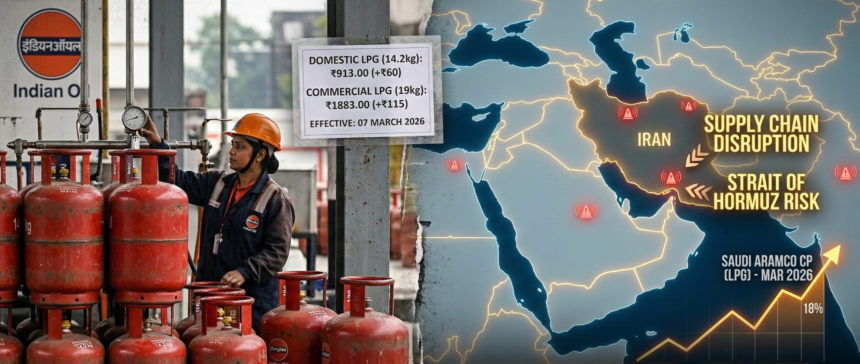
The recent 60 Rupee LPG Hike reflects a critical pivot in India’s retail energy sector, triggered by the escalating West Asia conflict and Strait of Hormuz disruptions. By raising domestic prices by ₹60 and commercial rates by ₹115, the government aims to buffer midstream under-recoveries while testing the nation’s import-dependency resilience amidst global supply chain volatility.
Market Analysis & Current Trends: Navigating the 60 Rupee LPG Hike
The global energy landscape in early 2026 has been fundamentally upended by the deepening geopolitical tensions in West Asia, creating a ripple effect that led directly to the 60 Rupee LPG Hike. As a direct consequence of military confrontations involving major regional powers, international benchmark prices for Liquefied Petroleum Gas have decoupled from historical seasonal averages. India remains uniquely exposed to this volatility because the nation continues to rely on imports for approximately 60% of its total LPG requirements.
The primary market driver behind the 60 Rupee LPG Hike is the localized “Hormuz Risk Premium,” which reflects the extreme difficulty of navigating the world’s most vital energy chokepoint. With 20% of global oil transit currently under threat, the logistical costs associated with securing fuel have become prohibitively expensive. This hike serves as a necessary release valve for state-run refiners who have maintained a price freeze despite mounting midstream costs.
Comparative Data & Eligibility Breakdown
The economic impact of the 60 Rupee LPG Hike is best understood through a metropolitan price comparison. The following table illustrates the revised pricing structure effective from March 2026 across India’s primary commercial hubs, highlighting the disparity between subsidized and market rates.
| City | Domestic LPG (14.2 kg) | Commercial LPG (19 kg) | Net Impact of 60 Rupee LPG Hike |
| New Delhi | ₹913.00 | ₹1,883.00 | Domestic +₹60 / Commercial +₹115 |
| Mumbai | ₹912.50 | ₹1,835.00 | Domestic +₹60 / Commercial +₹115 |
| Kolkata | ₹939.00 | ₹1,990.00 | Domestic +₹60 / Commercial +₹115 |
| Chennai | ₹928.50 | ₹2,043.50 | Domestic +₹60 / Commercial +₹115 |
| Ujjwala (Delhi) | ₹613.00* | N/A | Domestic +₹60 / Commercial +₹115 |
Pricing reflects the sustained ₹300 subsidy for Ujjwala beneficiaries to buffer the 60 Rupee LPG Hike.
Strategic Future Outlook: Projections Post-60 Rupee LPG Hike
Expert financial analysts suggest that if the West Asia conflict extends beyond the current quarter, a further secondary adjustment to the 60 Rupee LPG Hike could be inevitable. The current breakeven point for refiners is estimated to be near ₹987 per cylinder, suggesting that the domestic market is still being shielded by state-mandated caps. For the commercial sector, the ₹115 surge is expected to trigger a significant increase in operational overheads for the hospitality and bakery industries. Many analysts project a secondary wave of “menu inflation” by April 2026 as these businesses pass their increased energy costs onto the end consumer . Learn more about the future of energy risk management in our Savitimes.com professional guide.
From a career and recruitment perspective, the 60 Rupee LPG Hike is accelerating a massive demand for Energy Risk Analysts and Supply Chain Diversification Experts. Major firms like IOCL and HPCL are aggressively hiring professionals capable of navigating international trade law and hedging energy commodities to secure non-Middle Eastern supply lines.
Industrial Infrastructure & Logistics
The “Industrial Infrastructure” managing the supply chain behind the 60 Rupee LPG Hike is currently operating under a sophisticated “Priority-First” digital framework. Under the Essential Commodities Act, the government has hardcoded new logic into the enterprise resource planning systems of domestic refineries. This tech-driven mandate ensures that LPG output is maximized for domestic bottling plants over industrial exports, prioritizing social stability over immediate export revenue . View the latest verified global price benchmarks on Bloomberg Energy.
The new “25-day booking” logic is now a hard constraint within the digital distribution platforms used by Oil Marketing Companies. By utilizing real-time data from localized distribution hubs, the system can predict regional demand surges and reroute supplies automatically, ensuring that the 60 Rupee LPG Hike does not result in local black markets.