

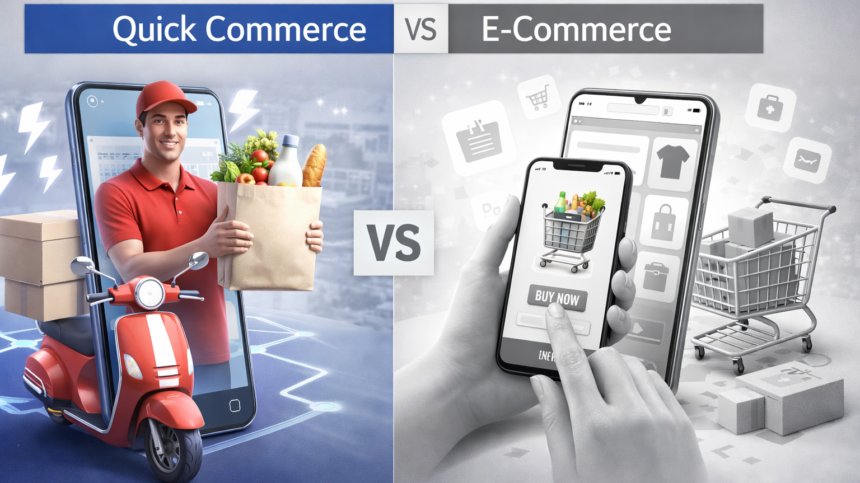
The retail landscape of Quick Commerce vs E-Commerce is experiencing a 30% Growth Disruption as Quick Commerce (Q-Commerce) shifts from groceries to high-margin electronics. Led by Blinkit, Zepto, and Swiggy, this “10-minute” model is cannibalizing traditional E-Commerce shares, forcing giants like Amazon to pivot toward hyperlocal fulfillment to retain urban dominance.
Executive Summary
As of 2026, the 30% Growth Disruption defines the rapid migration of consumer spending from scheduled deliveries to instant fulfillment. For C-suite executives, this shift represents more than just speed; it is a fundamental restructuring of the supply chain from centralized regional hubs to decentralized neighborhood “Dark Stores.” While traditional E-Commerce remains the “King of Variety,” Q-Commerce has effectively captured the “King of Convenience” title.
Competitive Advantage & Risk Assessment
https://www.reuters.com/business/The Quick Commerce vs E-Commerce highlights a significant shift in Market Share, where Q-Commerce platforms utilize a “High-Frequency Touchpoint” strategy that E-Commerce cannot match. By delivering daily essentials, these platforms stay at the top of the user’s mind, creating a massive Competitive Advantage when that same user decides to buy a high-value gadget.
Discover how small retailers are adapting to this shift in our Retail Strategy Guide on Savitimes.com. For deep-dive financial analysis on retail stocks, visit the Reuters Business Desk.
Strategic Comparison Table
| Metric | Quick Commerce (Blinkit/Zepto) | Traditional E-Commerce (Amazon) | Modern Retail (Reliance/Tata) |
| Price-to-Performance | High (Convenience Premium) | Optimal (Value-Centric) | Moderate (Physical Trust) |
| Scalability | Hyper-Local (Tier 1 & 2) | Global/National (All Tiers) | Regional (Physical Reach) |
| Market Reach | High Density Urban | Universal | Omnichannel Hybrid |
| Keyword Impact | 30% Growth Disruption | Defensive Adaptation | Collaborative Integration |
Socio-Economic Impact
The Quick Commerce vs E-Commerce is reshaping the urban workforce by creating a massive demand for gig-economy delivery partners, yet it poses a structural threat to the traditional MSME sector. Small “Kirana” shops are finding their proximity advantage neutralized by dark stores that offer better discounts and faster service. To survive, local retailers must leverage “Human Trust” and the “Khata” (credit) system, which digital algorithms cannot replicate. Furthermore, the surge in 10-minute deliveries has accelerated the “Electric Vehicle Revolution,” as platforms transition to 100% EV fleets to manage the high operational costs of frequent, short-distance trips.
Financial Logic & Future Forecast
The financial sustainability of the Quick Commerce vs E-Commerce rests on the transition from low-margin FMCG to high-margin “New Commerce.” Blinkit’s valuation surge to over $13 billion in 2026 is driven by its ability to push Average Order Values (AOV) higher through electronics and beauty products. The “Economic Moat” is no longer just the app, but the proprietary data on neighborhood-level consumption patterns. Over the next five years, we forecast a “Great Convergence,” where E-Commerce giants will acquire Q-Commerce players to offer a unified “Dual-Speed” delivery app. The winner of this battle will be the one who masters “Predictive Stocking”—placing the product in a dark store before the customer even knows they want to buy it.
Business FAQs
Is it a good investment?
The Quick Commerce vs E-Commerce indicates a high-growth sector, but it remains speculative. Investors should focus on companies like Zomato (Blinkit) that show a clear path to EBITDA positivity through high ad-revenue and category expansion.
Who is the target demographic?
The primary demographic is the “Time-Poor, Cash-Rich” urban professional aged 22–45 who prioritizes immediate gratification and reliability over seeking the absolute lowest price found on traditional sites.
What is the 5-year outlook?
Expect total market consolidation. The distinction between Quick Commerce vs E-Commerce will vanish, replaced by a single “Unified Retail” experience where delivery speed is simply a filter selected at checkout.