


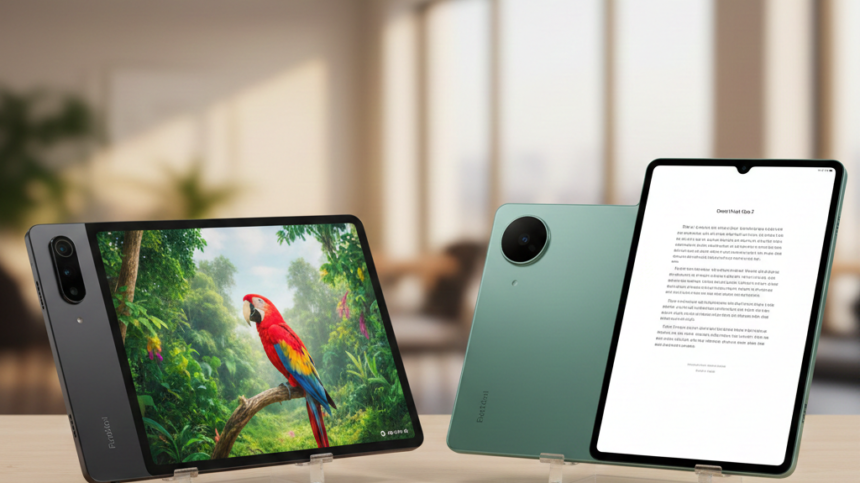
Quick Access: The 25K Tablet Verdict
If you are hunting for a powerhouse under Rs 25,000, the Redmi Pad 2 Pro offers a rugged metal build, IP53 durability, and a massive 12,000 mAh battery for long-haul users. However, for those prioritizing a superior visual experience, the OnePlus Pad Go 2 dominates with a 7:5 aspect ratio, significantly higher brightness, and faster UFS 3.1 storage. While Redmi wins on raw endurance and physical ports like the 3.5mm jack, OnePlus takes the crown for software fluidity and multimedia immersion.
The Battle of Premium Aesthetics and Rugged Build Quality
When it comes to the physical presence of these devices, the Redmi Pad 2 Pro makes a striking first impression with its full metal unibody construction. This choice of material not only provides a premium cold-to-the-touch feel but also ensures a level of structural integrity that plastic alternatives simply cannot match. In a segment where durability is often overlooked, Redmi has gone a step further by including an IP53 rating, offering much-needed protection against dust and minor water splashes. This makes the Redmi Pad 2 Pro a more reliable companion for students or professionals who are constantly on the move and need a device that can withstand the rigors of daily travel.
On the other side of the ring, the OnePlus Pad Go 2 opts for a polycarbonate build that, while sleek and well-finished, lacks the “heft” and premium resonance of its competitor. OnePlus has focused its design language on a unique 7:5 aspect ratio, which makes the tablet feel more like a traditional book or notepad when held in portrait mode. While the Redmi Pad 2 Pro features a traditional 16:10 ratio perfect for cinematic content, the OnePlus ergonomics are tailored for productivity and reading. It is important to note that the Redmi Pad 2 Pro also retains the beloved 3.5mm headphone jack, a feature that is becoming increasingly rare in 2026 but remains essential for users who prefer lag-free wired audio.
Comparison Table: Redmi Pad 2 Pro vs. OnePlus Pad Go 2
| Feature | Redmi Pad 2 Pro | OnePlus Pad Go 2 |
| Price (Base) | ~₹24,999 | ~₹26,999 |
| Build Material | Metal Unibody | Polycarbonate (Plastic) |
| Processor | Snapdragon 7s Gen 4 | MediaTek Dimensity 7300 Ultra |
| RAM / Storage | LPDDR4X / UFS 2.2 | LPDDR5X / UFS 3.1 |
| Display Brightness | 466 Nits | 860 Nits |
| Aspect Ratio | 16:10 (Media Focus) | 7:5 (Reading Focus) |
| Battery Capacity | 12,000 mAh | 10,500 mAh |
| Charging Speed | 33W | 45W |
| Durability | IP53 Rating | No Official Rating |
| Audio Jack | Yes (3.5mm) | No |
| Software | Android 15 (HyperOS) | Android 16 (OxygenOS) |
Processing Power and the Efficiency of Modern Storage
Under the hood, we see a clash between two very different silicon philosophies that define the user experience of the Redmi Pad 2 Pro and its rival. The Redmi tablet is powered by the Snapdragon 7s Gen 4, a reliable mid-range chipset that delivers consistent 60fps performance in popular titles like Call of Duty Mobile. However, the Redmi Pad 2 Pro is somewhat held back by its use of LPDDR4X RAM and UFS 2.2 storage technology. In the fast-paced world of 2026, these storage speeds can lead to slightly longer app loading times and slower file transfers compared to the more advanced standards found in the flagship killers of the same price range.
Conversely, the OnePlus Pad Go 2 integrates the MediaTek Dimensity 7300 Ultra paired with significantly faster LPDDR5X RAM and UFS 3.1 storage. This combination effectively doubles the read and write speeds, making the entire interface feel snappier and more responsive during heavy multitasking. While the Redmi Pad 2 Pro might hold a slight lead in raw GPU stability during long gaming sessions, the day-to-day “zip” and smoothness of the OnePlus Pad Go 2 are undeniable. Users who frequently move large files or install heavy applications will find that the OnePlus hardware stack offers a more future-proof investment for their hard-earned money.
Software Soul: HyperOS Versatility vs OxygenOS Fluidity
The soul of a tablet lies in its operating system, and the choice between the Redmi Pad 2 Pro running HyperOS and the OnePlus Pad Go 2 with OxygenOS is a matter of personal taste. HyperOS on the Redmi Pad 2 Pro is functional and offers unique features like dual floating windows, allowing power users to juggle multiple tasks simultaneously with ease. However, many critics argue that the interface lacks the refined animations and “organic” feel that have become the hallmark of the OnePlus software experience. The Redmi Pad 2 Pro also ships with Android 15, which feels like a slight missed opportunity given that the OnePlus Pad Go 2 comes out of the box with the newer Android 16.
OnePlus has clearly invested more into the “AI Era” with its OxygenOS implementation, providing tools like AI Writer, Voice Scribe, and an advanced AI Image Editor. These features turn the OnePlus Pad Go 2 into a smart assistant rather than just a digital slate. While the Redmi Pad 2 Pro promises seven years of security updates, it is important to remember that its major OS update cycle effectively starts one version behind its competitor. For those who value aesthetics, smooth transitions, and a clean, ad-free environment, the software experience on the OnePlus remains the gold standard in the budget-friendly tablet market.
Energy Endurance and the Speed of Recharging
Battery life is the lifeblood of any portable device, and the Redmi Pad 2 Pro packs a massive 12,000 mAh cell that sets a new benchmark for endurance. In continuous screen-on-time tests involving video playback and heavy web browsing, the Redmi device easily cleared 12 to 13 hours of usage, significantly outlasting the 8 to 10 hours provided by the OnePlus Pad Go 2. This makes the Redmi Pad 2 Pro the undisputed king for long flights or weekend trips where a charger might not be readily available. Furthermore, the Redmi tablet supports reverse wired charging, allowing it to act as a massive power bank for your smartphone in emergency situations.
Choose Redmi Pad 2 Pro if: You want a tank-like build, the longest possible battery life for travel, and still use wired earphones.
Choose OnePlus Pad Go 2 if: You want the best screen for movies, faster app loading speeds, and a smoother software experience
Frequently Asked Questions (FAQs)
Q1: Does the Redmi Pad 2 Pro support cellular connectivity? Yes, the Redmi Pad 2 Pro comes in both Wi-Fi only and 5G variants. The 5G model allows you to insert a SIM card for high-speed mobile data on the go, and it even features a slightly upgraded 13MP rear camera compared to the 8MP sensor found on the Wi-Fi base model.
Q2: Which tablet is better for gaming, the OnePlus Pad Go 2 or Redmi Pad? While both tablets perform admirably, the Redmi Pad 2 Pro is generally better for gaming due to its consistent 60fps performance in titles like Call of Duty and better thermal stability. The OnePlus Pad Go 2 has been noted to have occasional 30fps software glitches in certain games, though its faster RAM helps with overall game loading times.
Q3: Can I use a stylus with these tablets for note-taking? Both the Redmi Pad 2 Pro and the OnePlus Pad Go 2 offer official stylus support. Each brand sells its own dedicated pressure-sensitive pen separately for approximately ₹4,000. These are excellent for students who want to digitize their handwritten notes or for casual artists looking for a digital canvas.