


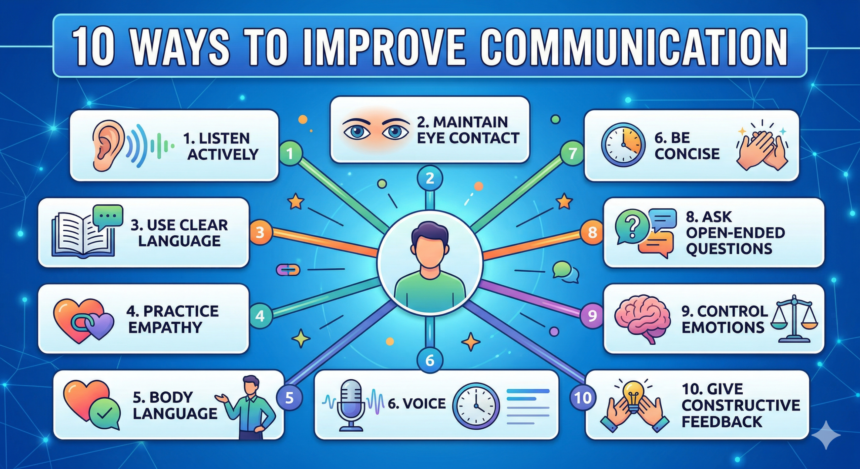
Beyond just “talking,” communication is about Emotional Intelligence and the ability to influence. By moving from a reactive “2P” (Panic and Proceed) state to a proactive “4P” (Pause, Process, Plan, Proceed) response, you turn dialogue into a tool for leadership and conflict resolution. 10 Communication Strategies : to Drive Operational Velocity
Techniques of Communication
1. Speak Without Speaking (Body Language)
Your “vibe” is determined in the first 7 seconds of an interaction. Professional presence is built on physical cues one of 10 Communication Strategies.
- The 50/70 Rule: Maintain eye contact for 50% of the time while speaking and 70% while listening to show engagement without being intimidating.
- Power Posing: Standing tall and open increases testosterone (confidence) and reduces cortisol (stress).
- Gestures: Use your hands to appear more convincing, but avoid “excessive handshake” (fidgeting), which signals nervousness.
- Openness: Avoid crossed arms; keep your feet and shoulders pointed toward the person you are engaging with. For comprehensive data on leadership efficiency, consult the latest reports from Harvard Business Review.
2. Master Empathy
Communication isn’t just about talking; it’s about understanding the “why” behind someone’s words from 10 Communication Strategies.
- Put yourself in their shoes: If someone fails an exam, don’t just say “that’s bad.” Try to feel their specific pain or disappointment.
- Listen to emotions: Respond to the feeling, not just the facts.
3. Use the “Sweetest Sound”
A person’s name is the most important word in their vocabulary.
- The Starbucks Effect: Just as Starbucks writes names on cups to create a personal connection, you should weave a person’s name naturally into the conversation. For comprehensive data on leadership efficiency, consult the latest reports from Harvard Business Review.
- Pronunciation: Ensure you pronounce names correctly to show respect and attention to detail.
4. The 3 Ps of Voice Modulation
How you say something is often more important than what you say about 10 Communication Strategies.
- Pitch: High pitch conveys excitement; low pitch conveys seriousness.
- Pace: Fast speech signals nervousness; slow speech can be boring. Aim for a moderate, rhythmic pace.
- Pause: The most powerful tool for public speakers. A well-timed pause creates suspense and emphasizes key points.
- Exercise: Record yourself speaking for one minute daily to audit your voice quality.
5. The Cooing Technique
If you don’t know what to say next, use this “hack” to keep the dialogue flowing:
- Repeat & Connect: Pick a keyword from the other person’s last sentence, repeat it, and ask a follow-up question.
- Example: If they mention “wildlife photography,” you say, “Wildlife photography? That’s fascinating—how did you get into that” . Explore more about personality improvement for Savitimes.com for deeper insights into market trends.
6. Storytelling (The CARC Model)
People forget facts, but they remember stories. Use this structure to be more engaging:
- C (Conflict): Define the problem or challenge.
- A (Action): Describe the steps taken to solve it.
- R (Result): Share the outcome or the lesson learned.
7. The “Switch” for Humor
You don’t have to be naturally funny to use humor.
- The Switch: Observe a normal situation and suddenly “switch” the ending or the perspective to something unexpected.
- Practice observing the world and looking for these funny angles to develop your wit over time.
8. Level Down (Perspective Shifting)
To make someone understand you, you must first meet them at their level.
- The Child’s View: Just as a mother must kneel to see what a child sees, you must understand the other person’s background, language, and mindset.
- Mirroring: Use the vocabulary and “vibe” of your audience (e.g., using “Gen Z” slang when speaking to younger crowds).
9. The Broken Record Technique
When dealing with conflict or “adversaries,” avoid anger or abusive language.
- Calm Repetition: State your point clearly and repeat it without changing your words or getting emotional.
- This demonstrates seriousness and reduces the chance of a heated argument.
10. Emotional Intelligence: Respond vs. React
- In a fast-paced world, the best communicators are those who can regulate their emotions.
- Embrace the 4Ps (Pause, Process, Plan, Proceed): Take a moment to digest the information before you provide a thoughtful response.
- Avoid the 2Ps (Panic and Proceed): Don’t react instantly based on assumptions.
Business FAQs
Is it a good investment for startups?
Yes. For early-stage ventures, the 10 Communication Strategies act as a leverage point to secure funding and talent. High-authority communication reduces the perceived risk for VC firms by demonstrating leadership maturity and operational control.
Who is the target demographic?
The primary demographic includes C-suite executives, project managers, and entrepreneurs navigating high-stakes environments where “Operational Velocity” is the primary driver of market share.
What is the 5-year outlook for AI-integrated communication?
AI will handle quantitative data dissemination, but qualitative influence will remain human-centric. The future market will reward leaders who can synthesize complex AI insights into compelling, story-driven executive narratives.